What Is Glass Skin — and Can HydraFacial Deliver It?
The Korean beauty concept of "glass skin" — a complexion so smooth, hydrated, and luminous it appears translucent — has moved from social media aesthetic to measurable clinical endpoint. At SkinArtMD in Burnaby, patients frequently ask whether a HydraFacial treatment can genuinely achieve this effect, or whether it remains aspirational marketing.
The honest answer begins with mechanism — and it is more biochemically interesting than the marketing suggests.
If you are curious whether HydraFacial is the right starting point for your glass skin goals, book a consultation with our team for a personalized skin assessment.
Mechanism of Action: What HydraFacial Does at the Cellular Level
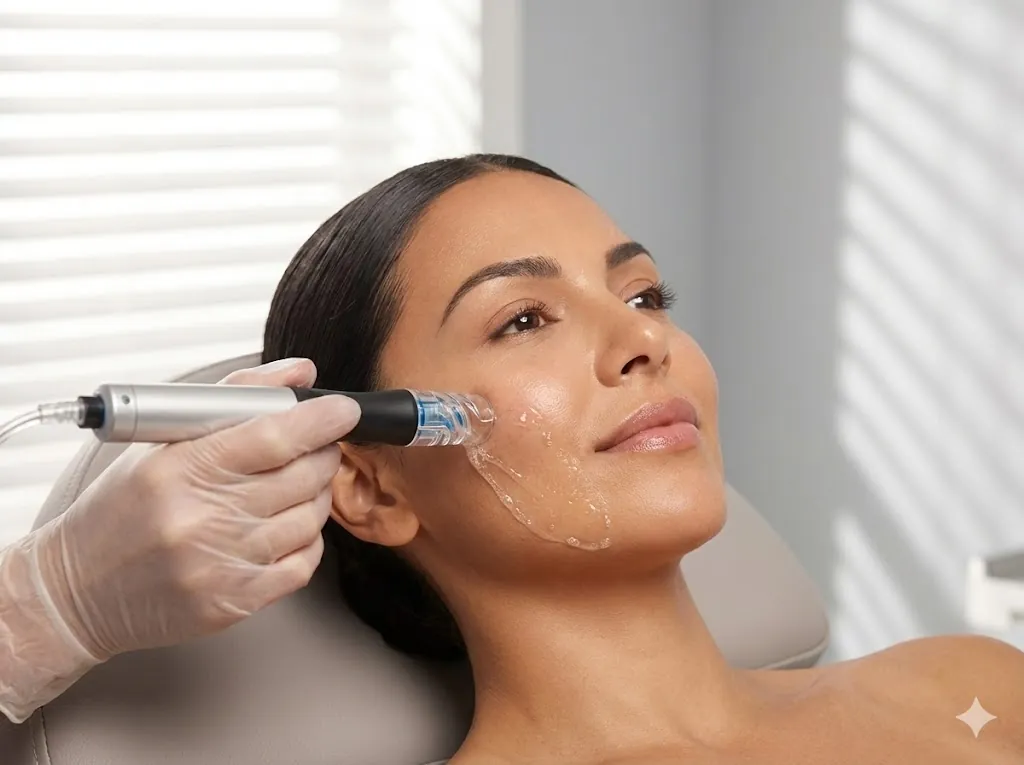
HydraFacial is a patented multi-step hydradermabrasion system that performs three simultaneous functions through a single vortex-tip handpiece: exfoliation, extraction, and serum infusion. Unlike traditional microdermabrasion — which relies on dry mechanical abrasion — HydraFacial's Vortex-Fusion® technology creates a negative-pressure irrigation system at the dermal-epidermal junction, delivering actives while removing debris in a single pass.
Step 1: Cleanse and Peel
Glycolic and salicylic acids in the ActiV-4™ serum loosen dead corneocytes from the stratum corneum. This is controlled chemical exfoliation — pH is calibrated to disrupt desmosomes (the protein bridges holding dead skin cells together) without breaching the stratum granulosum. The result is a clean exfoliation plane rather than surface trauma associated with aggressive peels.
Step 2: Extract and Hydrate
The vortex suction dislodges sebaceous debris, hyperkeratotic plugs, and oxidized sebum from follicular orifices. This is the biochemical process behind comedone clearance and the congested texture that blocks the glass skin effect. The Beta-HD™ serum used in this phase contains salicylic acid and honey extract to further liquefy sebum for more effective removal.
Step 3: Fuse and Protect
Hyaluronic acid (HA), growth factors, antioxidants (vitamin C, resveratrol), and peptides are infused under mild negative pressure — driving actives into now-patent follicular channels and the disrupted stratum corneum. HA exhibits hygroscopic properties, attracting and binding water molecules at approximately 1,000 times its own weight. This step is most directly responsible for the immediate luminosity and plumpness associated with glass skin.
The Biochemistry of Glass Skin: Hydration and Light Reflection
Glass skin is fundamentally an optical phenomenon. Highly hydrated keratinocytes in the stratum corneum swell slightly, smoothing surface microrelief. When skin surface roughness drops below a threshold where specular reflection dominates over diffuse light scatter, the skin reads as luminous and translucent — the visual signature of glass skin.
HydraFacial addresses this at three biochemical levels:
1. TEWL Reduction By removing compromised outer corneocyte layers, the underlying stratum corneum's lipid lamellar structure is transiently exposed, then supported by infused ceramide-adjacent peptides that reinforce the skin barrier. Reduced transepidermal water loss means retained hydration throughout the day.
2. Aquaporin Engagement Emerging research suggests that transdermal HA fragments may interact with aquaporin-3 (AQP3) channels in keratinocytes, facilitating improved water transport across cell membranes. Research by Pallasch et al. published in the Journal of Dermatological Science examined transdermal HA delivery and its interaction with aquaporin pathways — providing a mechanistic basis for HA-driven hydration improvement beyond simple surface moisturization.
3. Melanin Redistribution Superficial chemical exfoliation selectively targets melanin-laden corneocytes, which disproportionately contribute to uneven tone. This redistribution effect — explored by Moy et al. in the Journal of Cosmetic Dermatology — helps explain why patients with hyperpigmentation frequently report the most dramatic glass skin improvement after a consistent series of HydraFacial sessions.
Clinical Evidence Summary
HydraFacial has been evaluated in peer-reviewed literature across three primary outcome domains: skin hydration, surface texture, and pigment.
Hydration and Texture Tremblay et al., publishing in Skin Research and Technology, conducted a controlled comparison of hydradermabrasion versus standard microdermabrasion. The hydradermabrasion group demonstrated statistically significant improvements in skin moisture content and surface smoothness at 48 hours post-treatment. The simultaneous serum infusion — absent in traditional microdermabrasion — was identified as the key differentiating mechanism.
Acne and Comedonal Clearance Freedman et al., in the Journal of Clinical and Aesthetic Dermatology, examined hydradermabrasion in patients with mild-to-moderate acne vulgaris and non-inflammatory comedones. Results showed measurable reduction in open comedone counts following a single session, with cumulative benefit across a four-session protocol — consistent with the extraction mechanism described above.
Photoaging and Pigment Gold et al., publishing in the Journal of Cosmetic Dermatology, assessed hydradermabrasion combined with growth factor serums in patients presenting with photoaging markers: fine lines, tactile roughness, and mottled pigmentation. Blinded photographic assessments showed improvement across all three parameters, with texture showing the earliest and most consistent response — directly relevant to the glass skin endpoint.
HydraFacial is not a replacement for clinically validated photorejuvenation modalities such as intense pulsed light (IPL) or fractional laser resurfacing. Its strongest evidence base is for hydration, luminosity, and mild comedonal clearance — precisely the combination that produces the glass skin effect.
HydraFacial vs. Adjacent Facial Treatments
| Feature | HydraFacial | Traditional Microdermabrasion | Superficial Chemical Peel | IPL Photofacial |
|---|---|---|---|---|
| Exfoliation method | Mechanical + chemical | Mechanical only | Chemical only | None |
| Simultaneous serum infusion | Yes | No | No | No |
| Downtime | None | Minimal | 1–7 days | Minimal |
| Immediate skin hydration | High | Low | Variable | Low |
| Pigment targeting | Mild | Mild | Moderate | Strong |
| Suitable for sensitive skin | Yes (adjustable) | Moderate | Caution | Caution |
| All Fitzpatrick skin types | Yes | Moderate | Limited | Limited |
| Glass skin as primary outcome | Yes | Partial | Partial | Not applicable |
For patients whose primary goal is the glass skin effect — luminosity, hydration, and surface evenness — HydraFacial's combined profile is difficult to match with any single-modality alternative, particularly for patients with darker or more reactive skin tones.
Candidate Evaluation: Who Is a Good Candidate?
At SkinArtMD in Burnaby, candidate evaluation for HydraFacial is conducted under physician oversight. Dr. Sharon Fong, our CPSBC-registered physician specializing in medical aesthetics, injectables, and anti-aging, evaluates each patient's Fitzpatrick skin type, active skin conditions, and current topical regimen before recommending a HydraFacial protocol — or a combination approach when appropriate.
Ideal candidates typically present with:
- Mild-to-moderate dullness, dehydration, or textural irregularity
- Fitzpatrick skin types I–VI — the protocol is adjustable across all skin types, a significant clinical advantage over chemical peels and ablative lasers
- Concerns including fine lines, enlarged pores, uneven skin tone, or early photoaging
- Mild-grade active acne or chronic comedonal congestion
- Patients seeking a no-downtime facial treatment that fits an active schedule
Book a consultation for a comprehensive skin assessment — our team will determine whether HydraFacial alone or as part of a combination protocol best serves your glass skin goals.
Patients requiring a modified protocol or additional evaluation:
- Rosacea in active flushing stage — exfoliation and suction can transiently increase erythema; a gentler tip and adjusted serum selection are used
- Active eczema or psoriasis over the treatment area
- Patients on high-concentration retinoids, systemic isotretinoin, or who have had recent ablative procedures (a minimum rest interval applies)
- Pregnancy — not contraindicated per device labeling, but elective aesthetic treatments are generally deferred per standard medical practice
Limitations and Contraindications
HydraFacial is among the safest facial treatment modalities available. Transparency about its limitations is part of how we practice at SkinArtMD.
What HydraFacial does not do:
- It does not stimulate neocollagenesis (new collagen synthesis). For structural anti-aging — skin laxity, deep wrinkles, volume loss — modalities such as Morpheus8, Thermage, or Sculptra are more appropriate.
- It does not permanently reduce sebaceous activity. Moderate-to-severe acne typically requires adjunct medical therapy.
- Single-session glass skin results are transient — typically 5–7 days of peak hydration — without a maintenance protocol.
Absolute contraindications:
- Active herpes simplex lesions over the treatment area
- Open wounds, active sunburn, or skin abrasions
- Known allergy to any serum component (glycolic acid, salicylic acid, hyaluronic acid)
- Active keloid formation history over the facial treatment area
Regulatory status: HydraFacial is cleared by Health Canada and the FDA for aesthetic skin resurfacing in clinical settings.
What to Expect: The HydraFacial Session at SkinArtMD
A standard HydraFacial session at SkinArtMD in Burnaby takes approximately 30–45 minutes with no downtime. Many patients across the Greater Vancouver area schedule sessions during their lunch hour and return directly to work.
Session flow:
- Pre-treatment skin analysis and Fitzpatrick classification
- Double cleanse to remove SPF, makeup, and environmental particulate
- Vortex-Exfoliation pass with ActiV-4™ serum
- GlySal™ peel pass (glycolic/salicylic blend), adjusted to skin type
- Beta-HD™ extraction pass with vortex suction
- Personalized booster serum infusion — vitamin C, growth factors, or Dermabuilder™ peptides selected based on your primary concern
- Broad-spectrum SPF application; no additional topicals required
Glass skin results — visible hydration, smoothness, and luminosity — are typically apparent within hours, peaking at 24–48 hours post-treatment.
Why Choose SkinArtMD for Your HydraFacial?
Many clinics offer HydraFacial as a menu service. What distinguishes the SkinArtMD experience is the physician-led clinical context.
Physician oversight: Every new patient consultation involves a physician-supervised skin assessment under Dr. Fong's direction. You receive a treatment plan tailored to your specific skin concerns — not just a single session booking.
Advanced booster selection: We use the full HydraFacial booster ecosystem, selecting serums based on your clinical presentation. Hyperpigmentation, dehydration, acne, and fine lines each respond to different infusion protocols — and choosing correctly matters.
Bilingual care: Our team in Burnaby serves both English and Mandarin-speaking patients from across the Greater Vancouver area. Many of our clients in Burnaby prefer to discuss their skin concerns in Mandarin — and patients often tell us that receiving guidance in their preferred language made them far more confident in their treatment decisions. We offer consultations in both English and Chinese (普通话).
Personalized combination protocols: For patients whose goals include both the glass skin effect and structural improvement, our medical team can design protocols pairing HydraFacial with injectables, laser, or radiofrequency — addressing multiple layers of skin aging simultaneously.
Limited consultation spots are available. Book a consultation to secure your skin assessment with our medical team.
Frequently Asked Questions
How many HydraFacial sessions do I need to achieve glass skin? Most patients see meaningful improvement after a single session — immediate hydration and luminosity are consistent outcomes. For sustained glass skin results, particularly for tone, pore minimization, and fine lines, a series of 4–6 sessions spaced 2–4 weeks apart is typically recommended, followed by monthly maintenance sessions.
Is HydraFacial safe for Asian and darker skin tones? Yes — this is one of HydraFacial's most important clinical advantages. The absence of thermal energy and the adjustability of exfoliation intensity make it appropriate for Fitzpatrick types IV–VI, which carry elevated risk for post-inflammatory hyperpigmentation (PIH) with more aggressive modalities such as ablative lasers or deeper chemical peels.
Can HydraFacial help with acne? For mild-to-moderate comedonal and inflammatory acne, the evidence supports benefit. The extraction phase physically removes comedones, while the salicylic acid component provides sebum-regulating effects. Moderate-to-severe acne typically requires a physician-guided skincare program alongside or instead of device treatment — our medical team will advise on the appropriate approach.
Does HydraFacial hurt? Most patients describe the sensation as a mild vacuum-like pressure or gentle tingling. There is no pain, no significant heat, and no recovery period. It is consistently described as one of the most comfortable professional facial treatments available.
How long do HydraFacial results last? The hydration peak is typically visible for 5–7 days. With regular maintenance sessions, cumulative texture and pigment improvements are more durable — many patients report their skin settling into an improved baseline over the course of several months of consistent treatment.
How much does HydraFacial cost at SkinArtMD? Contact us for current pricing. We offer single sessions and series packages; our team will recommend the protocol that best suits your skin goals and budget.
Next Steps
If glass skin is your goal, HydraFacial at SkinArtMD provides a medically sound, evidence-supported path — particularly when guided by a physician-led assessment that matches the right booster protocol to your specific skin concerns. Understanding your Fitzpatrick type, current barrier status, and whether your primary concern is hydration, pigment, texture, or acne congestion determines which protocol produces the most visible result for you specifically.
Ready to See What HydraFacial Can Do for You? Our medical team at SkinArtMD in Burnaby is ready to create your personalized treatment plan. Book your complimentary consultation today — available in English and Chinese.
This article is for educational purposes only and does not constitute medical advice. Please consult with a qualified healthcare professional before undergoing any treatment.