

Ultherapy Body Burnaby
Micro-focused ultrasound for body skin laxity
Ultherapy Body uses micro-focused ultrasound (MFU/HIFU) at focal depths of 1.5, 3.0 and 4.5 mm to prompt collagen renewal while the skin surface stays intact. A physician assessment decides suitability, and results vary.
- 30–90 min
- Typical session, by area
- Same day
- Most resume normal routine
- 2–6 months
- Gradual change as collagen renews
- 30–90 min
- Typical session, by area
- Same day
- Most resume normal routine
- 2–6 months
- Gradual change as collagen renews
What Is Ultherapy Body in Burnaby?
Ultherapy Body is a non-surgical treatment that uses micro-focused ultrasound to deliver heat at set depths beneath the skin while leaving the surface intact, prompting collagen renewal. At Skin Art MD in Burnaby (Metrotown) it can be planned for areas such as the abdomen, arms, thighs, knees and décolletage. Results vary.
Unlike radiofrequency devices that warm tissue more broadly, Ultherapy focuses ultrasound at discrete points at chosen depths. Body areas other than the décolletage are less commonly treated with Ultherapy than the face and neck, so the physician explains what to expect before you decide. For the face and neck, see our Ultherapy page.
Surface left intact
Ultrasound energy converges at set depths below the skin surface.
Selectable depths
Focal depths of 1.5, 3.0 and 4.5 mm can be matched to each area.
Décolletage protocol
The upper chest has its own dedicated planning.
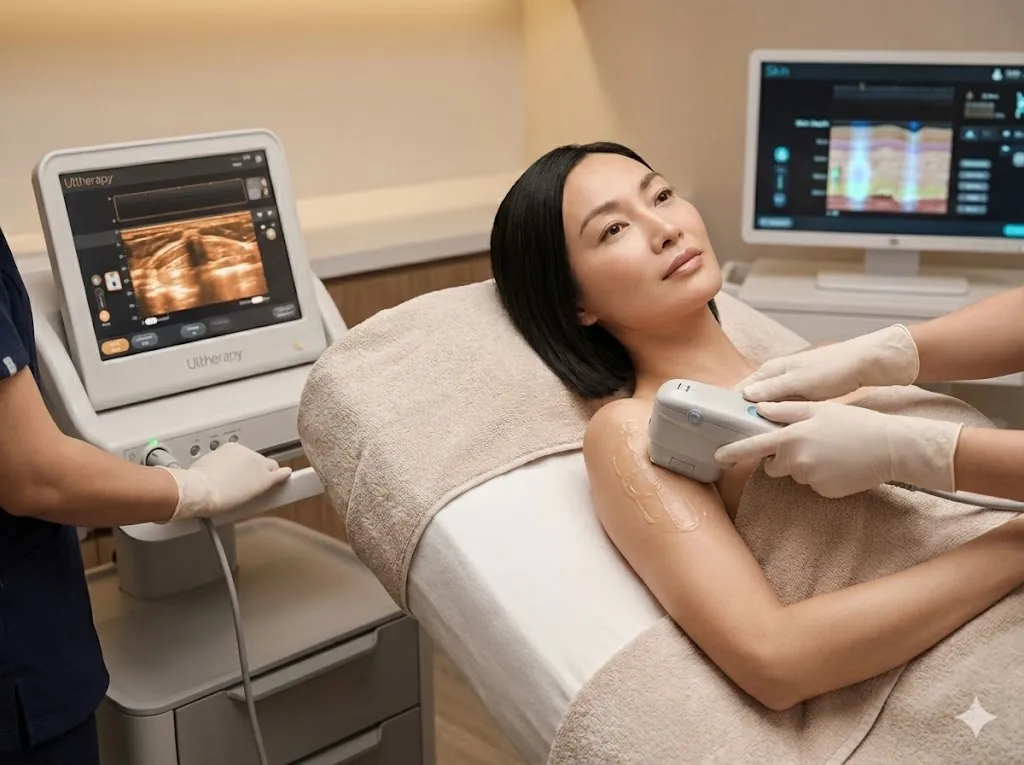
How Does Micro-Focused Ultrasound Work?
Ultrasound waves converge at controlled depths to create small points of thermal energy within tissue while the surface is spared. This differs from radiofrequency, which warms tissue more broadly.
Depth selection
Transducers target 1.5, 3.0 or 4.5 mm depths to suit each area.
Surface left intact
Ultrasound passes through the outer skin and concentrates at the chosen depth.
Imaging
Integrated imaging helps visualize tissue layers before treatment.
Collagen renewal
Small points of thermal energy prompt gradual collagen renewal over weeks to months.
Who Might Consider Ultherapy Body?
A physician assessment decides suitability. These are the common reasons people ask about it.
Commonly asked about by people who
- +Notice mild to moderate skin laxity on the body
- +Prefer a non-surgical approach where surface-sparing treatment matters
- +Notice abdominal skin laxity after pregnancy
- +Are interested in décolletage texture
- +Prefer to avoid heating tissue in bulk
Needs physician review first
- –Pregnant or breastfeeding
- –Certain medical implants in or near the treatment area
- –Active infection or severe inflammation in the area
- –Expecting dramatic or surgical-level results
- –Certain neuromuscular conditions affecting the area
- –Blood thinners or a bleeding disorder (higher bruising risk)
- –Open wounds, severe acne or other skin lesions in the area
Why Have Ultherapy Body at Skin Art MD in Burnaby?
A physician-led skin clinic at Metrotown, with assessment before treatment.
Physician-led
Dr. Charles Jiang is Medical Director, and a physician assessment decides suitability.
Honest expectations
The physician explains how body use differs from face and neck, and what results are realistic.
Depth assessment
Pre-treatment evaluation decides which focal depths suit each area.
Combination planning
Where appropriate, Ultherapy can be sequenced with other body treatments.
Which Body Areas Can Ultherapy Treat?
Focal depth is chosen for each area's tissue. Results vary.
Abdomen
Skin laxity after pregnancy or weight change.
Upper Arms
Looseness on the back of the arms.
Inner Thighs
Skin laxity on the inner thigh.
Outer Thighs
Skin laxity on the outer thigh.
Knees
Loose skin around the knee.
Décolletage
Crepey texture and lines on the upper chest.
What Happens During an Ultherapy Body Visit?
Assessment, imaging-guided planning, then treatment and aftercare. A session typically takes about 30 to 90 minutes depending on the area, and comfort options are discussed beforehand.
Pre-Treatment Preparation
Comprehensive body assessment, photography, and focal-depth treatment planning
Review of medical history, implants, and current health status
Tell us about any blood-thinning medications
Mention retinoids or exfoliants you use so we can advise whether to pause them
Arrive with clean, product-free skin on the treatment area
Treatment Session
Skin Preparation
Cleanse the treatment area and apply ultrasound coupling gel to ensure proper focal-point energy transmission.
Real-Time Ultrasound Mapping
Integrated imaging is used to visualize tissue layers and confirm correct focal depth (1.5 / 3.0 / 4.5 mm) placement before treatment begins.
Focal-Point Energy Delivery
Systematic application of MFU pulses at selected depths across the treatment area, with the surface remaining undisturbed throughout.
Treatment Completion
Final tissue assessment, post-treatment care instructions, and discussion of the expected gradual collagen-response timeline.
After
Most people resume normal daily activities the same day
Mild redness, swelling or tenderness may occur and usually settles within hours to a few days
Use moisturizer and broad-spectrum sunscreen on treated areas
Avoid strenuous exercise and heavy lifting for 24-48 hours
Avoid saunas, hot tubs and prolonged heat for 1 week
Bruising, tingling or numbness can occur and may last several days, occasionally longer
**Individual results vary. More than one session may be discussed. Ultherapy Body is not a substitute for surgical lifting.
Ultherapy Body Burnaby: Common Questions
How much does Ultherapy body treatment cost in Burnaby?+
Cost depends on the areas treated and the planned lines. We do not publish prices online; the physician assessment confirms your plan and the cost.
Where can I get Ultherapy body treatment near Burnaby or Vancouver?+
Skin Art MD is at #101 – 4378 Beresford St, Burnaby (Metrotown), near Metrotown SkyTrain Station on the Expo Line. Hours are Tuesday to Sunday 10:00–18:00, closed Monday. Phone +1 (604) 639-2581.
How is Ultherapy Body different from Thermage or other RF body treatments?+
Ultherapy uses micro-focused ultrasound at discrete focal depths and leaves the skin surface intact. Thermage uses radiofrequency to warm tissue more broadly. Both prompt collagen renewal by different mechanisms; the physician advises which suits an area.
What does Ultherapy Body feel like?+
Most people feel brief warmth or a deep prickling sensation as each pulse is delivered. Settings can be adjusted for tolerability, and comfort options are discussed beforehand.
How many sessions are needed?+
Some people have a single session; larger areas or more laxity may involve more than one, spaced months apart. The physician recommends a plan after assessment.
When will I see results, and how long do they last?+
Changes are gradual. Some people notice early firmness within weeks, with further change around two to six months. Results are not permanent: how long they last varies, and there is less long-term data for body areas than for the face and neck. A yearly review may be suggested. Results vary.
Is there downtime, and what side effects are possible?+
Most people resume normal activities the same day. Temporary redness, swelling or tenderness is common. Some people have bruising, or tingling or numbness that can last several days, occasionally longer; rarely, nerve irritation causes temporary weakness or altered sensation. Contact the clinic if anything does not settle.
Can Ultherapy Body be combined with other treatments?+
Often yes. Focal ultrasound addresses skin laxity and may sit alongside treatments that target fat or muscle. The physician advises on combinations and sequencing.
Does Ultherapy remove fat?+
No. It is aimed at skin laxity, not fat reduction.
Is Ultherapy on the body as established as on the face?+
Ultherapy is more commonly used on the face, neck and décolletage. The physician explains how body use differs and what results are realistic.
Who should not have Ultherapy Body?+
People who are pregnant or breastfeeding, have certain implants in the area, or have active infection there should speak to the physician first.
How long does an Ultherapy Body session take?+
Typically about 30 to 90 minutes, depending on the size and number of areas and the depths planned. A décolletage session is usually at the shorter end; larger body areas take longer. Allow extra time for the physician-led assessment and imaging before treatment.
Questions About Micro-Focused Ultrasound for the Body?
Book an assessment at Skin Art MD, #101 – 4378 Beresford St, Burnaby, to discuss whether Ultherapy Body suits your areas of concern. Results vary.
Related treatments
Related articles
How it works, who it suits, and what recovery looks like:
- Non-Surgical Facelift in Burnaby: How Ultherapy Lifts the SMAS Layer
Ultherapy is a non-surgical facelift option that uses micro-focused ultrasound to reach the SMAS layer — the same layer addressed in a surgical facelift — without needles or incisions. How it works, what a session involves, and how results develop, from Skin Art MD at Metrotown, Burnaby.
- Ultherapy Body Burnaby BC: Non-Surgical Skin Tightening
What is Ultherapy Body? How micro-focused ultrasound lifts and tightens skin on the chest, abdomen, knees and arms, what a treatment involves, and how it compares with RF and surgery, at Skin Art MD in Burnaby.
- Ultherapy for Chest & Décolletage in Burnaby: Sun Damage and Skin Tightening
The décolletage is one of the first areas to show sun damage and aging. Ultherapy uses micro-focused ultrasound to lift, tighten and stimulate collagen in the chest area, and is often planned alongside facial Ultherapy. Here is how décolletage treatment works at Skin Art MD at Metrotown.
- Thermage FLX vs Ultherapy: How Radiofrequency and Focused Ultrasound Differ
Both are needle-free collagen treatments, but one warms a broad layer of skin with radiofrequency and the other places focused ultrasound points at set depths. Here is how the two technologies differ and what each visit involves at Metrotown.
