

Thread Lift in Burnaby (Aptos® PLACL Threads)
An immediate lift, then collagen support as the threads dissolve.
A thread lift uses fine dissolvable threads with small barbs to gently reposition sagging tissue, without surgery or incisions. Aptos PLACL threads give an immediate lift and, as they dissolve over roughly two years, stimulate collagen. At Skin Art MD in Burnaby's Metrotown, a physician plans the vectors for a natural contour.
- 30-60 min
- Typical Procedure Time
- Immediate
- Lift; Improves Over 3-6 Months
- ~1 week
- Typical Time to Resume Everyday Activities
- 30-60 min
- Typical Procedure Time
- Immediate
- Lift; Improves Over 3-6 Months
- ~1 week
- Typical Time to Resume Everyday Activities
How Does a Thread Lift Work?
A precise, minimally invasive way to lift the midface, jawline and brows while keeping your features. A physician assessment decides suitability.
Aptos uses third-generation PLACL threads, a blend of poly-L-lactic acid (PLLA) and polycaprolactone (PCL). The threads stay flexible while gradually dissolving over about two years, acting as a scaffold for your skin's own collagen and elastin production.
Immediate Refinement
Micro-barbs gently grip and lift tissue for an immediate improvement in contour.
Collagen Support
As the threads dissolve, collagen stimulation can improve skin texture and firmness over time.
Tailored Vectors
Custom vector design aims for a refreshed look, not a pulled or 'overdone' one.
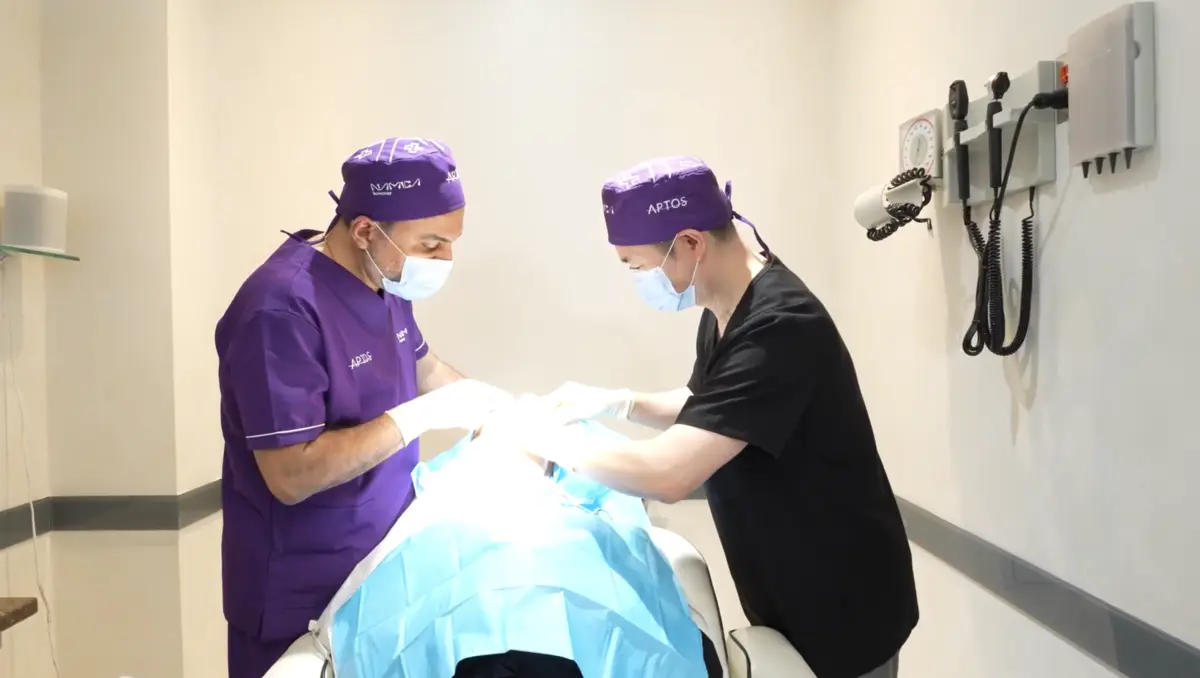
What Are PLACL Threads?
PLACL combines PLLA and PCL for flexible, dissolvable threads that support the tissue while collagen builds.
Seamless Placement
Threads are placed just below the skin surface using a fine cannula.
Grip & Lift
Bidirectional barbs act like tiny hooks, pulling tissue upward against gravity.
Structural Support
The threads form a fine mesh under the skin that gives structural support to the lifted tissue.
Regenerative Core
As threads dissolve, they stimulate a new collagen matrix that helps support the result.
Who Might Consider a Thread Lift?
A physician assesses your skin's elasticity and tissue weight to decide whether a thread lift suits you.
Commonly Discussed For
- +Early signs of lower-face sagging
- +Loss of jawline definition
- +Interest in a subtle V-shaped contour
- +A middle option between fillers and surgery
Not Suitable If
- –Pregnant or nursing
- –Advanced skin laxity that needs surgery
- –Severe acne or skin infection in the area
- –An active autoimmune condition affecting healing
- –A bleeding or clotting disorder, or blood thinners that cannot be paused (discuss with your physician)
- –An allergy to PLLA or PCL thread materials
How Do We Plan a Lift?
We design contours, not just place threads.
Vector Planning
We favour vertical lifting vectors designed to avoid widening the face.
Comfort-Focused
Local numbing techniques help keep the session comfortable.
Combination Planning
Threads for lift can be paired with skin boosters for skin quality, with timing planned by your physician.
Physician Direction
Treatment is performed under the direction of Dr. Sharon Fong, a physician.
Which Areas Can Be Treated?
Threads can be placed across several facial zones.
Mid-Face Lift
Elevate flattened cheeks and soften the nasolabial folds.
Defined Jawline
Supports the chin-to-jaw angle and early jowling.
Brow Arching
A subtle lift to open up the eye area.
Fox Eye Adjustment
Adjusts the lateral brow tilt for a sleeker eye shape.
Submental Contouring
Supports loose skin beneath the chin for a smoother profile.
What Happens During a Visit?
From initial assessment to recovery guidance.
Before You Arrive
Pause blood-thinning supplements (like fish oil) for 5 days
Refrain from alcohol for 24 hours prior
Come with a clean face, without makeup
Plan for several days of reduced social activity while swelling settles
The Procedure
Design & Marking
We map out the precise entry points and lifting vectors on your face.
Numbing
Local anaesthetic is applied to keep the procedure comfortable.
Thread Introduction
Using a micro-cannula, threads are smoothly guided into place.
The Reveal
Threads are adjusted to secure the lift, and the ends are trimmed.
Post-Care Rituals
Apply wrapped ice packs gently to manage swelling
Sleep on your back with your head slightly elevated for a week
Avoid wide yawning, big chewing, or intense workouts for 2 weeks
Skip facial massages and dental appointments for at least a month
Initial tightness is common and usually relaxes into a natural contour
The lift is visible straight away, and skin quality can continue to improve over about 3-6 months
**Individual results vary. Longevity depends on lifestyle and skin metabolism.
Common Questions
Will it look obvious that I have had treatment?+
The aim is a refreshed look rather than a pulled one. Threads reposition tissue to restore contour instead of stretching the skin, and vectors are planned to keep natural movement. Early swelling and tightness can look uneven for a week or two before the result settles.
What happens when the threads dissolve?+
The PLACL material breaks down gradually over about 18-24 months and is replaced by your own collagen. The face gradually returns toward its pre-treatment state, with improved skin quality for some people.
Can I feel the threads?+
You might feel slight tension, or a small pull when washing your face, in the initial weeks. Many people stop noticing them as tissue settles.
What is the recovery like?+
Mild swelling and possible bruising for 3-7 days is common, and you may notice slight skin puckering that settles quickly. Most people resume everyday activities in about a week.
How does a thread lift pair with fillers?+
Often well. Threads provide lift and fillers restore volume, so they are commonly combined for a full-face plan set by your physician.
What is an Aptos thread lift?+
A procedure that places fine dissolvable PLACL threads with micro-barbs under the skin through a small cannula to lift tissue and stimulate collagen as the threads dissolve.
Who performs the thread lift at Skin Art MD?+
Treatment is performed under the direction of Dr. Sharon Fong, a physician, with Dr. Charles Jiang as Medical Director.
What are the risks and side effects?+
Swelling, bruising, tenderness and skin dimpling are common and usually settle within one to two weeks. Less commonly, a thread can be felt or seen under the skin, the face can look uneven, or an infection can develop; rarely a thread needs adjusting or removal. Contact us about worsening swelling, spreading redness or fever.
Who should not have a thread lift?+
People who are pregnant or nursing, who have severe acne or skin infection in the area, who have an active autoimmune condition affecting healing, or whose laxity is advanced enough to need surgery.
How long does the procedure take?+
The visit typically takes 30-60 minutes. That includes marking the lift vectors and numbing with local anaesthetic; the threading itself usually takes about 30 minutes. You can usually go home straight afterwards.
How long do thread lift results last?+
Results are temporary. They commonly last around 12-18 months, while the PLACL threads themselves dissolve over about 18-24 months. The collagen they stimulate can support the tissue for a time, but the face keeps ageing. Duration varies with age, skin quality and metabolism.
Where can I get a thread lift in Burnaby?+
Skin Art MD is at #101 - 4378 Beresford St, Burnaby, BC, near Metrotown SkyTrain Station (Expo Line), serving Burnaby and Vancouver. Open Tuesday-Sunday 10:00-18:00, closed Monday. Phone +1 (604) 639-2581. Consultations are available in English, Mandarin and Cantonese.
Ready to Talk It Through?
Book a visit at Skin Art MD Metrotown, Burnaby. A physician will assess whether a thread lift suits your goals.
Related treatments
Related articles
How it works, who it suits, and what recovery looks like:
- Aptos Thread Lift in Burnaby: PDO & PLLA Threads for Non-Surgical Lifting and Collagen Stimulation
Aptos thread lifts offer an immediate lift plus longer-term collagen stimulation — no scalpel required. Learn how PDO and PLLA threads work, what results to expect, and what a thread lift visit at Skin Art MD at Metrotown in Burnaby involves.
- Aptos Thread Lift: How It Works & Who It's For
A science-focused look at the Aptos thread lift — mechanism of action, published evidence, what a candidate assessment considers, and honest limitations.
- InstaLift Burnaby: Non-Surgical Thread Lift Guide
Discover how Silhouette InstaLift in Burnaby lifts sagging skin without surgery. Learn about recovery, how long results last, and how it compares to PDO threads and Sculptra®.
