What Is an Aptos Thread Lift?
Learn more about Aptos Thread Lift at SkinArtMD, where our physician-led team guides every step of your aesthetic journey.
The Aptos thread lift is a minimally invasive, non-surgical facial rejuvenation technique that uses specialized absorbable sutures — threaded beneath the skin — to mechanically reposition soft tissue and stimulate the body's own collagen-production cascade. Unlike traditional surgical facelifts, which involve excision of skin and extended downtime, Aptos threads work with your biology rather than relying on gravity reversal alone.
At SkinArtMD in Burnaby, many patients researching their options are surprised to learn how much tissue repositioning is achievable without a single incision.
Mechanism of Action: What Happens Beneath the Skin
Mechanical Repositioning
Aptos threads are inserted via fine cannulas or needles under local anaesthetic. Each thread carries microscopic cogs, barbs, or cones — depending on the Aptos variant selected — that engage and anchor into the dermis and superficial subcutaneous fascia. Once deployed, the physician gently compresses tissue along the thread axis, physically elevating descended fat compartments and ptotic skin toward their original anatomical positions.
This mechanical lift is immediate, which is why many patients notice a visible difference on the same day of treatment. It is also what distinguishes Aptos threads from energy-based devices, which cannot reposition tissue — only tighten what remains in place.
Neocollagenesis: The Long-Game Biology
The more durable benefit of Aptos threads is biological. Depending on the specific Aptos product, threads are composed of polylactic acid (PLA), polydioxanone (PDO), or a poly-L-lactic acid/caprolactone (PLCL) copolymer — all fully biodegradable materials. As the suture undergoes hydrolytic degradation over several months, it triggers a controlled foreign-body inflammatory response:
- Fibroblast recruitment. The degrading polymer scaffold draws fibroblasts to migrate and proliferate around the implant site.
- Collagen I and III deposition. Activated fibroblasts synthesize new extracellular matrix proteins — predominantly collagen types I and III — that progressively thicken and firm the dermis along the thread's path.
- Myofibroblast contraction. A subset of recruited cells differentiates into myofibroblasts, which physically contract the surrounding connective tissue envelope, adding a secondary tightening effect.
The net result: even after the thread itself has fully resorbed (typically 6–18 months depending on material and individual metabolism), a reinforced collagen scaffold persists, sustaining lift and improving overall skin texture.
Clinical Evidence Summary
The peer-reviewed evidence base for absorbable barbed thread lifts has grown substantially, though large randomized controlled trials remain limited — a characteristic of the broader aesthetic procedure literature.
Savoia et al., Journal of Cutaneous and Aesthetic Surgery evaluated polylactic acid cone threads in a prospective cohort and reported clinically significant improvements in mid-face volume and nasolabial fold depth at 12-month follow-up. Histological analysis of biopsy specimens confirmed active neocollagenesis at thread implantation sites, and the authors noted the collagen response persisted measurably beyond complete thread resorption.
Sulamanidze et al., Aesthetic Surgery Journal — representing foundational work from the original Aptos research group — compared mechanical lift outcomes across multiple Aptos thread variants (needle, spring, and excellence) in a multi-year observational series. Patient satisfaction, measured using the FACE-Q instrument, was highest among individuals with mild-to-moderate tissue laxity, and cone-based thread designs demonstrated lift durability in the range of 18–24 months.
Paul et al., Dermatologic Surgery conducted a systematic review of cog and barb thread technologies and concluded that absorbable threads produce measurable tissue elevation verifiable by ultrasound imaging, with an acceptable safety profile in appropriately selected patients. Critically, the reviewers identified physician technique and thread placement depth as the primary determinants of both outcome quality and complication rate — underscoring why CPSBC-registered physician oversight is not optional for safe thread lift practice.
These findings are consistent with the clinical experience of Dr. Sharon Fong and the SkinArtMD team in Burnaby, where every thread procedure is preceded by a physician-conducted candidate evaluation.
Aptos Threads vs. Adjacent Technologies
Understanding how Aptos threads compare to other lifting and volumizing modalities helps patients and clinicians choose the most appropriate tool for a given presentation.
| Technology | Primary Mechanism | Tissue Effect | Downtime | Typical Duration |
|---|---|---|---|---|
| Aptos Thread Lift | Mechanical lift + neocollagenesis | Repositions descended tissue, firms dermis | 3–7 days | 12–24 months |
| PDO Threads (mono/screw) | Neocollagenesis only | Firms and tightens; minimal repositioning | 2–5 days | 6–12 months |
| Ultherapy / HIFU | Focused ultrasound thermal coagulation | Tightens SMAS fascia layer | Minimal | 12–18 months |
| Thermage FLX | Monopolar RF thermal remodeling | Skin tightening and contouring | Minimal | 12–18 months |
| Surgical Facelift | Skin and SMAS excision + repositioning | Maximum lift with skin removal | 2–4 weeks | 5–10 years |
| Dermal Fillers | Volume replacement / scaffolding | Restores lost volume, lifts via hydraulics | 1–2 days | 9–18 months |
Key distinction: Aptos threads occupy a clinically distinct niche by combining immediate mechanical repositioning — which fillers and energy devices cannot achieve — with long-term biological collagen induction — which a surgical facelift does not leverage. For patients with genuine tissue descent who are not yet surgical candidates, or who decline surgery, this dual mechanism may produce a more satisfying outcome than energy devices or fillers alone.
If you are weighing these options for your own situation, Book a Consultation with the physician team at SkinArtMD in Burnaby for an individualized assessment.
Candidate Evaluation Criteria
Appropriate patient selection is where thread lift outcomes are most powerfully determined — more so than any specific technique or thread brand.
Ideal Candidates
- Age range: Typically 35–60, though biological age (skin elasticity, tissue quality) matters more than chronological age
- Degree of laxity: Mild to moderate — tissue has descended but retains adequate elasticity to hold repositioned position
- Skin quality: Sufficient dermal thickness; thin, severely sun-damaged skin may not anchor threads effectively
- Subcutaneous volume: Adequate facial fat for thread anchoring; very thin faces risk thread palpability or visibility
- Expectations: Seeking a refreshed, natural result — not a surgical-level correction
- Health status: No active cutaneous infection, uncontrolled bleeding disorders, or autoimmune conditions affecting the planned treatment zone
Suboptimal or Contraindicated Candidates
- Severe skin laxity with significant excess skin redundancy — surgical excision may produce superior and more durable outcomes
- Active acne, rosacea flares, or cutaneous infections overlying the treatment zone
- Personal or family history of keloid or hypertrophic scarring
- Pregnancy or active breastfeeding
- Current anticoagulant or antiplatelet therapy (requires pre-procedure medication review and possible modification)
- Unrealistic expectations regarding the degree or permanence of correction
- Prior injection of silicone or other permanent fillers in the proposed thread pathway
Dr. Sharon Fong, CPSBC-registered physician and SkinArtMD's lead aesthetic practitioner, conducts individualized candidate assessments — including a structured medical history review, current medication evaluation, and standardized photographic analysis — before any thread procedure is scheduled. This physician-led evaluation protocol is a cornerstone of safe, reproducible outcomes at our Burnaby clinic.
Book a Consultation to begin your personalized evaluation.
What to Expect: The Procedure Step by Step
Demystifying the actual procedure reduces the anxiety many patients feel about anything in the "surgical-adjacent" category.
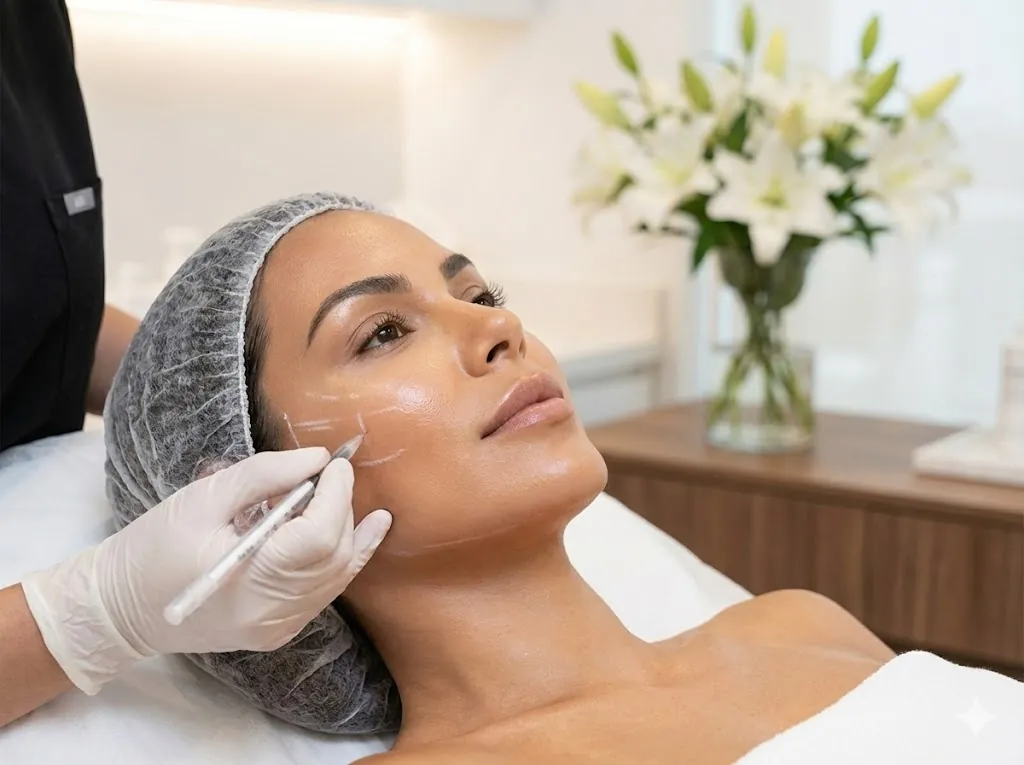
- Pre-procedure consultation and mapping. Thread entry points and lift vectors are planned and drawn on the face with the patient upright, accounting for gravitational anatomy and each patient's unique descent pattern.
- Topical and local anaesthetic. Numbing cream is applied 20–30 minutes before the procedure; lidocaine is then infiltrated along each planned thread pathway for complete comfort.
- Thread insertion. A fine needle or blunt cannula introduces each thread into the correct tissue plane — typically the superficial subcutaneous layer — guided by the physician's anatomical knowledge.
- Tissue compression and vector adjustment. The physician guides tissue along the thread axis, making real-time adjustments for symmetry and a natural-looking directional lift.
- Thread trimming and wound care. Entry points are 1–2 mm and typically require no sutures — a small adhesive dressing suffices. Antibiotic ointment is applied.
- Post-procedure instructions and follow-up. Patients leave the clinic with written aftercare instructions and return at 2 weeks and 3 months to assess outcomes and adjust the plan if needed.
Total procedure time is typically 45–90 minutes depending on the number of threads placed and the areas treated.
Limitations and What Thread Lifts Cannot Do
Transparency about limitations is a hallmark of ethical aesthetic medicine — and it is why we discuss these honestly at every SkinArtMD consultation.
- Thread lifts do not remove skin. Patients with significant skin redundancy will retain that excess after the procedure; threads reposition, not excise.
- Results are not permanent. Biodegradable threads resorb and the collagen scaffold they induce will eventually remodel over years. Most patients experience 12–24 months of primary benefit; maintenance threads or complementary treatments can extend this.
- Not a substitute for volume restoration. Significant fat atrophy — the "deflated" look — is better addressed with dermal fillers or fat grafting. Threads correct descent; they do not replace lost volume.
- Technique-dependent outcomes. As Paul et al. emphasized in their systematic review, operator skill is a primary outcome variable. Physician-administered thread procedures carry a materially different risk/benefit profile than those performed by unlicensed or inadequately trained providers.
- Recognized side effects: Dimpling, temporary asymmetry, thread palpability, bruising, and — rarely — infection or thread migration are documented complications. These risks are substantially reduced by careful candidate selection, sterile technique, and correct anatomical plane placement by a trained physician.
Why Choose SkinArtMD for Your Thread Lift?
Patients researching thread lifts across Burnaby and Greater Vancouver encounter a wide range of providers. Here is what distinguishes SkinArtMD:
Physician-led care throughout. Every thread procedure at SkinArtMD is planned and performed by a CPSBC-registered physician. Patients often tell us this was the deciding factor in choosing our clinic — the assurance that a physician is physically present and clinically accountable for every stage of their care.
Bilingual consultation and aftercare. Our Burnaby clinic serves a richly diverse Greater Vancouver community. Full consultations and aftercare instructions are available in both English and Mandarin (普通话), so nothing important is lost in translation.
Personalized, anatomy-driven treatment planning. There is no standard thread protocol at SkinArtMD. Facial anatomy, tissue quality, degree of descent, and patient goals drive every decision — including whether threads are combined with complementary treatments like fillers or energy devices for a more complete result.
Current technique and technology. SkinArtMD uses Aptos-certified thread products and our physicians maintain active training in thread lift technique, a field that has evolved considerably in recent years.
Transparent, upfront pricing. Contact us for current pricing — we believe honest conversations about cost belong in the consultation room, not buried in fine print.
Frequently Asked Questions
How long does an Aptos thread lift last? Most patients experience primary lift effects lasting 12–24 months. The collagen induction cascade triggered by thread resorption can extend skin quality improvements beyond this window. Individual results depend on age, baseline skin condition, lifestyle factors, and the specific thread design used.
Is a thread lift painful? The procedure is performed under local anaesthetic. Most patients describe the sensation as mild pressure or tugging rather than pain during insertion. Post-procedure soreness and tenderness are common for 3–5 days and are typically manageable with over-the-counter analgesics.
What does recovery look like after a thread lift? Expect mild-to-moderate swelling, bruising, and possible dimpling at entry points for 3–7 days. Patients are advised to avoid vigorous facial massage, extreme facial movements, and strenuous exercise for 2 weeks. Most return to normal daily activity within a few days, with makeup coverage managing any residual bruising.
Can thread lifts be combined with other treatments? Yes — and thoughtful combination approaches often produce the most balanced, natural-looking outcomes. Threads address tissue descent; dermal fillers restore lost volume; energy-based devices address skin texture and laxity. At SkinArtMD, Dr. Fong may recommend a sequenced multi-modality protocol based on your individual anatomy and goals.
Are Aptos threads approved for use in Canada? Health Canada has cleared absorbable suture materials for use in thread lift procedures. At your consultation, it is appropriate to confirm that the specific threads your physician plans to use carry current regulatory clearance — this is a standard and reasonable question for any patient to ask.
How does an Aptos thread lift differ from a standard PDO thread lift? Aptos threads are distinguished by their proprietary barb and cone geometries and material engineering, which are designed to produce measurable mechanical tissue repositioning in addition to collagen induction. Standard PDO mono or screw threads primarily stimulate neocollagenesis with minimal mechanical lift effect. Aptos threads are generally the appropriate choice when tissue repositioning — not just skin quality improvement — is the primary treatment goal.
Next Steps
If you are in Burnaby, Greater Vancouver, or anywhere across the Lower Mainland and are wondering whether an Aptos thread lift is right for you, the single most valuable next step is a physician consultation — not another evening of online research. A qualified physician can evaluate your tissue quality, map your facial anatomy, and give you an honest assessment of what threads can and cannot realistically achieve for you.
Dr. Sharon Fong and the SkinArtMD team are available for comprehensive, unhurried assessments. Bring your questions. Bring reference photos if you have them. We will give you a candid, medically grounded answer.
Book a Consultation — available in English and Mandarin. Limited consultation spots are available each week.
Ready to See What Aptos Thread Lift Can Do for You?
Our medical team at SkinArtMD in Burnaby is ready to create your personalized treatment plan. Book your complimentary consultation today — available in English and Chinese.
This article is for educational purposes only and does not constitute medical advice. Please consult with a qualified healthcare professional before undergoing any treatment.