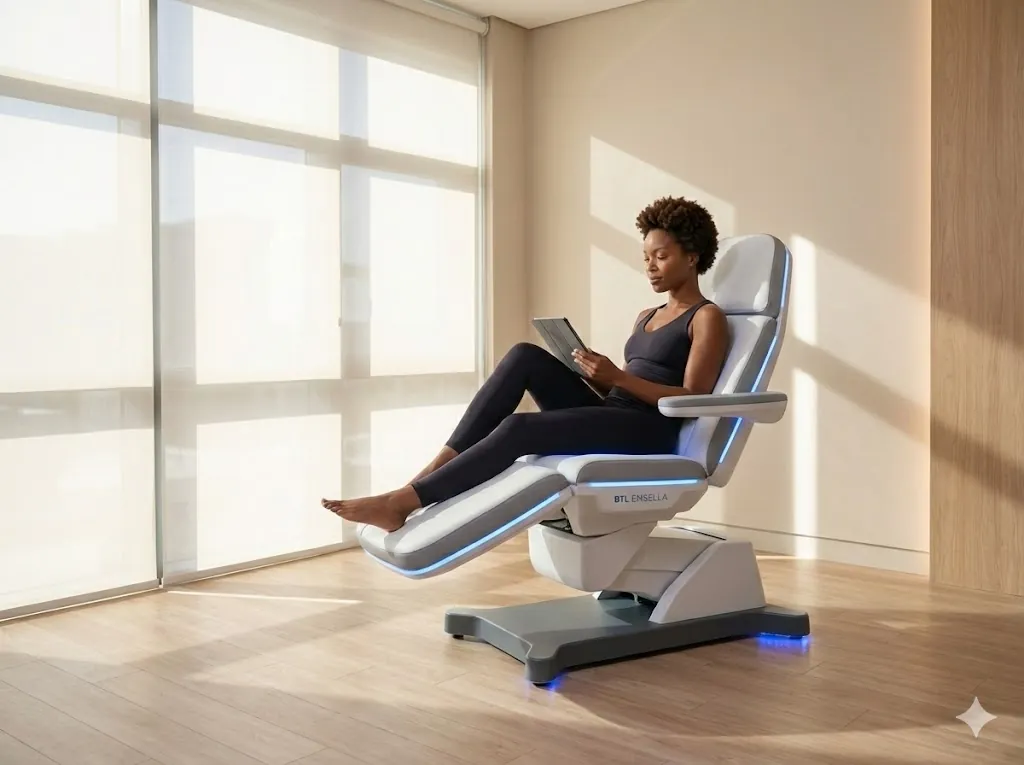
EMSella is a chair-based HIFEM device that uses focused electromagnetic energy to trigger strong pelvic floor muscle contractions while you stay fully clothed. Studies cited below report fewer leakage episodes in stress and mixed urinary incontinence; a physician assessment decides whether it suits your type of incontinence.
For many people in Burnaby and the Greater Vancouver area, urinary incontinence and pelvic floor weakness are deeply personal concerns — ones that affect daily confidence, physical activity, and intimate relationships.
EMSella offers a non-invasive, clinically supported path to addressing these issues. If you are researching this treatment, this article dives into the science, evidence, and clinical considerations behind the technology. Learn more about EMSella for a full overview of how we offer this treatment at Skin Art MD.
What Is EMSella and How Does It Work?
EMSella is a High-Intensity Focused Electromagnetic (HIFEM) therapy device designed specifically for pelvic floor rehabilitation. It delivers focused electromagnetic energy through a specially designed chair, inducing thousands of supramaximal pelvic floor muscle contractions during a single 28-minute session — contractions far exceeding what voluntary exercise can achieve.
The Mechanism of Action: HIFEM Technology
The electromagnetic field generated by EMSella penetrates through clothing and tissue, directly stimulating the motor neurons of the pelvic floor musculature. According to the manufacturer, the device induces approximately 11,000 contractions per session at peak intensity. At the cellular level, repeated supramaximal contractions trigger several key adaptations:
- Myofibril hypertrophy: Muscle fiber enlargement through increased actin-myosin cross-bridge cycling
- Neuromuscular re-education: Restoration of coordinated motor unit recruitment patterns, which is critical in stress urinary incontinence (SUI) where fast-twitch fiber response is impaired
- Connective tissue remodeling: Increased collagen and elastin synthesis in the pelvic fascia and ligaments supporting the bladder neck and urethra
- Improved resting tone: Sustained low-level activation that maintains baseline support between contractions
This differs mechanistically from electrical stimulation (e-stim) devices, which activate superficial nerve pathways. HIFEM penetrates deeper tissue layers without surface electrode contact, allowing whole-muscle recruitment rather than isolated fiber groups.
What does the clinical evidence show for EMSella?
Randomized and cohort studies report fewer incontinence episodes, better questionnaire scores and stronger pelvic floor muscles after HIFEM therapy, with earlier-stage evidence for postpartum recovery and no serious adverse events reported.
The evidence base for HIFEM pelvic floor therapy has grown substantially. Multiple peer-reviewed trials have examined its efficacy across different patient populations.
Stress and Mixed Urinary Incontinence
Gilling et al., published in Neurourology and Urodynamics, conducted a randomized sham-controlled trial examining HIFEM therapy in women with stress or mixed urinary incontinence.
The study demonstrated statistically significant reductions in incontinence episodes and pad use, alongside objective improvements in pelvic floor muscle strength measured by perineometry. Samuels et al., in the International Urogynecology Journal, reported a prospective cohort study tracking patients through a standard six-session protocol.
Findings showed meaningful reductions in International Consultation on Incontinence Questionnaire (ICIQ) scores — a validated patient-reported outcome tool — and improvements sustained at three-month follow-up. Silantyeva et al., in the Journal of Women's Health, evaluated HIFEM versus pelvic floor physical therapy in a comparative design.
Both groups showed improvement, but the HIFEM cohort achieved equivalent outcomes in shorter time and with higher patient compliance — a clinically relevant finding for patients who struggle with adherence to home exercise regimens.
Emerging Evidence in Postpartum Recovery and Prolapse
Additional research has explored EMSella-class HIFEM therapy in postpartum pelvic floor recovery and early-stage pelvic organ prolapse. While the evidence in these areas is earlier-stage, preliminary data suggests benefits in pelvic floor coordination and subjective symptom reduction. Consistent across studies is a favorable safety profile, with no serious adverse events reported in published trials.
Quality-of-Life Outcomes
Across studies, quality-of-life improvements — measured by tools such as the ICIQ-SF and King's Health Questionnaire — consistently parallel objective findings. Patients report improved confidence, reduced limitation in physical activities, and better sexual function. These patient-centered outcomes are increasingly recognized as co-primary endpoints in urogynecology research.
What is EMSella used for?
EMSella is a medical device used for the treatment of urinary incontinence and to improve quality of life. As a medical device rather than a wellness gadget, it is used in physician-supervised clinical settings.
How does EMSella compare with other pelvic floor treatments?
EMSella sits between home exercises and procedural options: it is non-invasive and done fully clothed, with a shorter course than physiotherapy, but it does not replace surgery for structural problems.
Understanding EMSella's clinical niche requires situating it within the broader landscape of pelvic floor interventions.
| Treatment | Mechanism | Invasiveness | Sessions Needed | Requires Undressing |
|---|---|---|---|---|
| EMSella (HIFEM) | Supramaximal EM contractions | Non-invasive | 6 (standard) | No |
| Kegel exercises | Voluntary muscle contraction | Non-invasive | Daily, ongoing | No |
| Pelvic floor physiotherapy | Manual + biofeedback | Non-invasive | 8–16+ | Yes (partial) |
| E-stim (TENS/NMES) | Electrical nerve stimulation | Minimally invasive | 6–12 | Yes |
| Radiofrequency (intravaginal) | Thermal collagen remodeling | Minimally invasive | 3 | Yes |
| Surgical sling | Mechanical urethral support | Surgical | 1 (OR) | Full anesthesia |
| Key differentiators: EMSella produces supramaximal contractions beyond the voluntary maximum — a level patients with already-weakened pelvic floors cannot generate through Kegel exercises alone. The fully clothed, seated format lowers practical and psychological barriers compared to intravaginal or surgical options. The standard six-session protocol completes in three weeks, enabling quicker clinical assessment of patient response versus prolonged physiotherapy courses. EMSella is often used as a standalone treatment or in combination with pelvic floor physiotherapy, depending on severity and individual goals. Book a Consultation to discuss which approach fits your situation.
Who is EMSella commonly considered for?
EMSella is mainly discussed for stress and mixed urinary incontinence and postpartum or menopausal pelvic floor changes; a physician assessment of the incontinence type decides suitability. Physician-led evaluation is essential to identify the urinary incontinence subtype and confirm HIFEM suitability.
Situations commonly assessed
- Stress urinary incontinence (SUI): Leakage triggered by coughing, sneezing, laughing, or exercise — the defining presentation of sphincter and levator ani weakness
- Mixed urinary incontinence: SUI component present alongside urgency-type symptoms
- Postpartum pelvic floor rehabilitation: Vaginal delivery frequently disrupts pelvic floor integrity; EMSella offers a non-gynecologic pathway to recovery
- Perimenopause and menopause: Estrogen decline reduces tissue integrity; EMSella may complement hormonal or topical therapies
- Patients seeking non-surgical options: Those who have not responded adequately to exercise alone but wish to avoid surgery or intravaginal procedures
Situations where EMSella is less suited
- Pure urgency urinary incontinence (UUI): Driven primarily by detrusor overactivity (overactive bladder), not sphincter weakness. EMSella may offer partial benefit but is not the primary indicated therapy.
- Overflow incontinence or neurogenic bladder: Underlying etiology requires specialist management; HIFEM does not address structural or neurological causes.
- Severe pelvic organ prolapse (Stage III–IV): Structural correction may be needed before or instead of HIFEM.
At Skin Art MD in Burnaby, everyone considering EMSella has a structured intake and consultation. Dr. Sharon Fong, a physician, leads the evaluation, and each patient is assessed before any treatment plan is confirmed. Book a Consultation to begin your evaluation.
What happens during an EMSella treatment?
EMSella is delivered in a series of sessions — the standard protocol is six sessions over three weeks, with two sessions per week. Each session is approximately 28 minutes.
Step-by-step process:
- Patient arrives fully clothed and is seated on the EMSella chair
- Chair settings are calibrated to patient comfort and clinical goals
- Electromagnetic pulses begin — patients feel a distinct tingling and involuntary muscle contraction, typically described as an intense rhythmic sensation rather than pain
- Intensity is gradually increased to therapeutic levels over the first several minutes
- Session concludes; no wound care is required
Most people resume work or daily activities the same day, and there is nothing to apply or manage afterward.
Timeline and Results
Clinical improvement in pelvic floor tone and incontinence frequency typically begins emerging from sessions three and four onward.
Maximum effect is usually assessed at six to eight weeks after completing the full protocol, once muscle remodeling has had time to stabilize.
Individual responses vary based on baseline pelvic floor status, age, delivery history, and hormonal factors.
Maintenance sessions — typically once every three to six months — can help sustain results over time. Our team will provide a personalized maintenance recommendation based on your initial response.
What are EMSella's limitations and contraindications?
EMSella is not used with metal implants in the pelvic region, cardiac devices, pregnancy or pelvic malignancy, and it does not treat bladder overactivity or neurological or anatomical causes of leakage.
Absolute contraindications
- Metal implants in the pelvic region: Metallic IUDs, pelvic surgical hardware, or implanted nerve stimulators (e.g., sacral neuromodulation devices) are contraindicated due to electromagnetic interaction
- Cardiac pacemakers or implantable defibrillators
- Active pregnancy
- Malignancy in or near the pelvic treatment area
Relative considerations
- Copper IUDs: Non-metallic IUDs (hormonal, plastic) are generally acceptable; copper IUDs require physician and manufacturer guidance before proceeding
- Anticoagulant therapy: No incisional risk is present, but full patient history should be reviewed
- Severely atrophied or denervated muscle: Markedly reduced neuromuscular response may limit treatment effect in advanced cases
Clinical Limitations
EMSella strengthens the muscular and connective tissue layer of the pelvic floor — it does not address detrusor overactivity, neurological causes of incontinence, or anatomical abnormalities requiring surgical correction.
Results require the muscle to respond to electromagnetic stimulus. Without continued neuromuscular engagement through maintenance sessions, gradual return toward baseline tone can occur over time.
Why Choose Skin Art MD?
At Skin Art MD in Burnaby, EMSella is offered as physician-supervised care — not just a device session.
Here is what distinguishes our approach:
- Physician-led evaluation: Every EMSella candidate is assessed by our medical team before a single session is booked. The assessment determines whether EMSella suits your presentation and shapes the treatment plan.
- Integrated aesthetic and functional care: For patients navigating both pelvic floor changes and other menopausal or postpartum concerns, we can coordinate a broader plan addressing multiple goals within one practice.
- Bilingual care: Our team serves patients in both English and Mandarin Chinese (普通话) — an important consideration for many Greater Vancouver families navigating sensitive health topics.
- Medical-grade technology: EMSella is part of a device portfolio selected with published clinical evidence in mind. Its seated, clothed and private format can make it easier to raise a concern that is often kept quiet.
What do people ask about EMSella?
Common questions cover how the treatment feels, how many sessions are involved, when results appear, combining it with other care, insurance, use in men, and telling incontinence types apart.
Is EMSella painful? Most patients describe the sensation as unusual rather than painful — a strong, rhythmic involuntary contraction. Intensity is adjusted to patient tolerance and most find it comfortable once the first few minutes of calibration pass.
How many sessions will I need? The standard protocol is six sessions over three weeks.
Some patients with more significant baseline pelvic floor weakness may benefit from additional sessions. Individual plans are determined at consultation.
Will I see results after the first session? Some patients notice subtle improvement early, but meaningful clinical results typically build across the full protocol. Maximum effect is generally visible six to eight weeks after the last session, once tissue remodeling has stabilized.
Can EMSella be combined with other treatments? Yes. EMSella can complement pelvic floor physiotherapy, hormonal therapy, or other non-invasive pelvic treatments. Our physician team can advise on appropriate combination protocols based on your goals.
Is EMSella covered by insurance in BC? As an elective medical aesthetic treatment, EMSella is generally not covered by BC MSP or extended health benefits. Fees are not listed online and are explained at a consultation.
Is EMSella only for women? While most published research focuses on women, HIFEM pelvic floor therapy has also been studied in men — particularly for post-prostatectomy incontinence. Discuss eligibility at your consultation.
How do I know if I have stress versus urgency incontinence? This distinction requires a clinical history and sometimes urodynamic testing. It is the primary reason we require a physician consultation before booking — incontinence subtype matters significantly for treatment selection.
Next Steps
If you have been researching EMSella and recognize yourself in the candidate profile described above, the next step is a one-on-one consultation with our physician team.
At Skin Art MD in Burnaby, we will review your history, confirm your incontinence subtype, and build a realistic treatment plan with clear timelines and expectations. Book a Consultation today — available in English and Mandarin Chinese.
Ready to See What EMSella Can Do for You? Our medical team at Skin Art MD in Burnaby is ready to create your personalized treatment plan. Book a consultation — available in English and Chinese.
This article is for educational purposes only and does not constitute medical advice. Please consult with a qualified healthcare professional before undergoing any treatment.