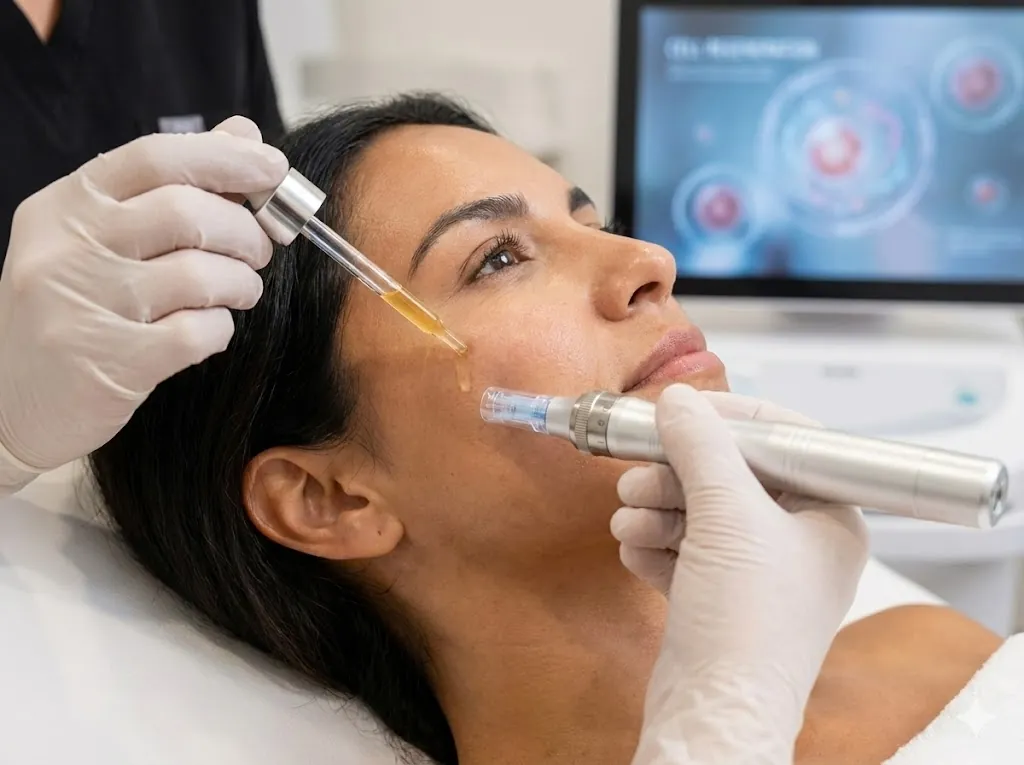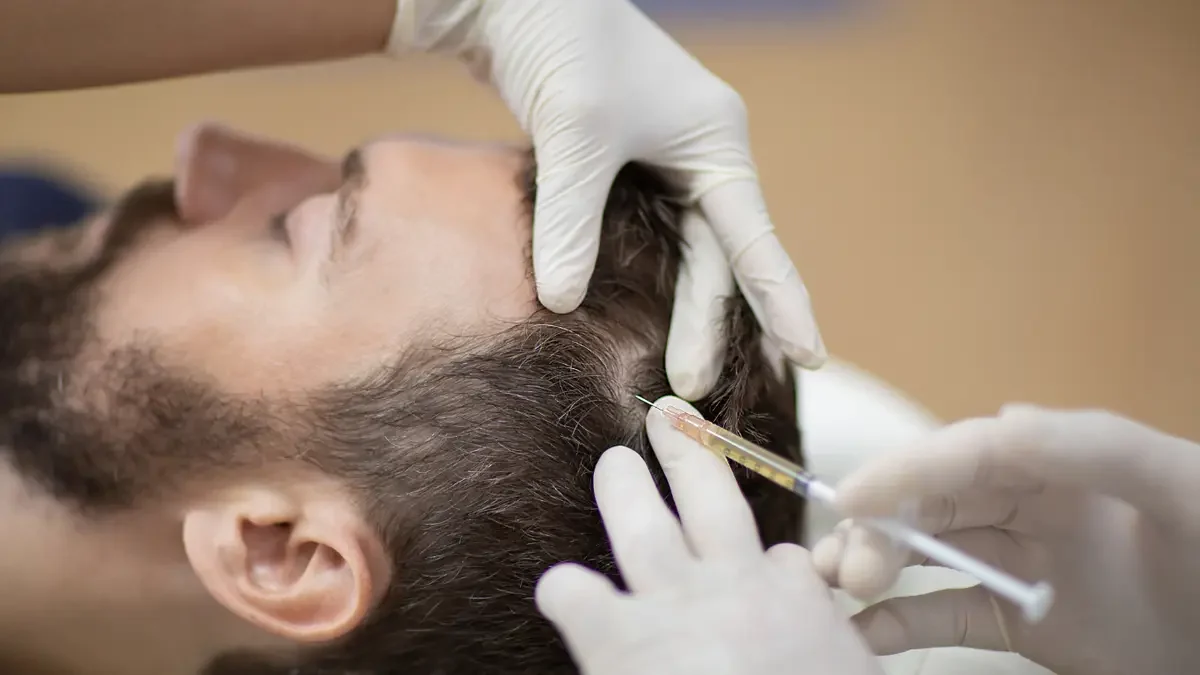
PRP hair restoration concentrates platelets and growth factors from your own blood and injects them into the scalp to stimulate miniaturized follicles. Published trials report improved density in early-to-moderate pattern hair loss; results appear over 3–6 months after a series of 3–4 sessions, maintenance is needed, and a physician assessment decides suitability.
How Does PRP Work for Hair Loss?
Platelet-rich plasma (PRP) hair restoration leverages your own blood's regenerative biology to stimulate dormant hair follicles. The process begins with a simple blood draw. A centrifuge separates the plasma layer — rich in platelets — from red blood cells. The resulting PRP concentrate contains platelet concentrations several times higher than whole blood, packed with growth factors that govern tissue repair and cellular regeneration.
When injected into the scalp, these growth factors — including platelet-derived growth factor (PDGF), vascular endothelial growth factor (VEGF), transforming growth factor-beta (TGF-β), and insulin-like growth factor (IGF) — bind to receptors in hair follicle cells. This triggers a cascade of downstream signaling:
- PDGF stimulates dermal papilla cell proliferation — the cells at the base of each follicle that control hair growth cycling.
- VEGF promotes angiogenesis (new blood vessel formation), improving nutrient and oxygen delivery to the follicle microenvironment.
- TGF-β helps regulate the hair growth cycle, potentially shifting follicles from the telogen (resting) phase toward the anagen (active growth) phase.
- IGF supports follicle cell survival and differentiation.
The net effect is a biochemical signal to the follicle: wake up, grow, and sustain. For follicles that are miniaturized — the hallmark of androgenetic alopecia — PRP may partially reverse this miniaturization by restoring the cellular environment that supports healthy hair shaft production.
Learn more about PRP Hair Restoration
What Does the Research Show About PRP for Hair Loss?
The evidence base for PRP in hair loss has grown substantially. Multiple randomized controlled trials and systematic reviews have examined its efficacy across different populations and alopecia types.
Androgenetic Alopecia
Alves and Grimalt, publishing in Dermatologic Surgery, conducted a randomized half-head trial in patients with androgenetic alopecia. Participants receiving PRP injections showed statistically significant improvements in hair density and hair shaft caliber compared to the placebo-treated side. The study highlighted that PRP's effects were most pronounced in the vertex and frontal scalp regions — areas with the highest follicular density.
Gentile et al., in a study published in PLOS ONE, evaluated PRP using both clinical measurement and histological analysis. Biopsies from PRP-treated scalp showed measurable increases in follicle density, Ki-67 proliferation markers, and vascular density — cellular-level confirmation of the growth factor mechanism described above, not just surface-level hair count changes.
Alopecia Areata
Trink et al., publishing in the Journal of the American Academy of Dermatology (JAAD), compared PRP with a standard corticosteroid injection in alopecia areata and reported favourable regrowth and recurrence results for PRP, suggesting possible immunomodulatory effects — a finding that has prompted further investigation into PRP's T-regulatory cell pathways.
Systematic Review Evidence
A meta-analysis by Gupta and Carviel, published in the Journal of Dermatological Treatment, synthesized data across multiple PRP hair studies. The pooled analysis supported PRP as an adjunct treatment for hair loss with a favorable safety profile, while noting that standardization of PRP preparation protocols — platelet concentration, activation method, injection depth — remains an area requiring further research.
It is important to interpret this evidence with nuance. Study populations vary, PRP preparation kits differ, and "response" is defined differently across trials. Individual results depend on the underlying cause of hair loss, follicle viability, and treatment adherence.
How Does PRP Compare With Other Hair Loss Treatments?
PRP sits between topical or oral medication and surgery: it uses your own growth factors through scalp injections, is less invasive than a transplant, and is often used alongside medical therapy rather than alone.
| Treatment | Mechanism | Invasiveness | Evidence Level | Typically used for |
|---|---|---|---|---|
| PRP | Autologous growth factors, follicle stimulation | Minimally invasive (injections) | Moderate RCT evidence | Early–mid androgenetic alopecia |
| Topical hair-growth medication | Vasodilation, potassium channel opening | Topical (non-invasive) | Long-established | Several alopecia types |
| Oral prescription DHT blockers | DHT suppression via 5α-reductase inhibition | Oral (non-invasive) | Established, mainly in males | Primarily male androgenetic alopecia |
| Low-Level Laser Therapy | Photobiomodulation, mitochondrial activation | Non-invasive | Moderate | Adjunct in androgenetic alopecia |
| Hair Transplant (FUE/FUT) | Surgical follicle relocation | Surgical | Established | Advanced loss with donor availability |
A key feature of PRP is its autologous nature — using your own biological material avoids immunological rejection and the systemic side effect profiles of oral medications. It sits between topical agents and surgery: more targeted than topical products, and less invasive than a transplant.
PRP is often used as a complement to medical therapy rather than a standalone. Combined protocols — PRP alongside topical treatment, or after transplant surgery to support transplanted follicles — are increasingly common in clinical practice.
Who Is PRP Hair Restoration Usually Discussed For?
PRP is generally discussed for early-to-moderate thinning where follicles are miniaturized but still present, and a physician evaluation of the scalp, medical history and blood work decides suitability.
Not every person with hair loss responds equally to PRP, so a physician evaluation at Skin Art MD in Burnaby comes first.
Commonly Discussed For
- Individuals with early-to-moderate androgenetic alopecia (male or female pattern hair loss), where follicles are miniaturized but not yet absent
- Patients with alopecia areata, particularly in conjunction with other therapies
- Those experiencing diffuse thinning from nutritional deficiencies or telogen effluvium, once the underlying trigger is addressed
- Patients looking to support hair transplant surgery, either pre- or post-procedure
- Individuals interested in non-surgical options who have realistic expectations
What the Physician Evaluates at Consultation
The physician performs a detailed scalp examination, often using dermoscopy to assess follicular density, miniaturization patterns, and scalp inflammation. A full medical history review addresses:
- Duration and pattern of hair loss
- Family history (genetic predisposition)
- Current medications — anticoagulants, for example, affect candidacy and timing
- Nutritional status: iron, ferritin, vitamin D, and thyroid function; deficiencies must be corrected first
- Platelet count and overall blood health
Diffuse thinning can be hormonal, nutritional or stress-related, and a physician-led assessment helps distinguish these presentations — treating the wrong mechanism won't produce the hoped-for result.
Book a Consultation to have your scalp assessed by a physician before starting any treatment plan.
What Are the Limitations and Contraindications of PRP?
PRP cannot regrow hair where follicles are gone, needs several sessions and ongoing maintenance, and is avoided with active scalp infection, platelet or blood disorders, anticoagulant therapy, active cancer, significant immunosuppression or pregnancy.
PRP is well-tolerated, but it is not appropriate for everyone, and understanding its limitations leads to better outcomes.
Contraindications
- Active scalp infection or inflammatory skin conditions — PRP may exacerbate active flares of seborrheic dermatitis or scalp psoriasis
- Blood disorders or platelet dysfunction — PRP relies on platelet function; thrombocytopenia or qualitative platelet defects compromise efficacy
- Anticoagulant therapy (warfarin, direct oral anticoagulants) — requires physician assessment of bleeding risk and altered platelet function
- Active cancer or history of haematological malignancy — growth factor delivery in oncology contexts requires specialist consultation
- Systemic infections or significant immunosuppression — increases risk of procedure-related complications
- Pregnancy — PRP is not recommended during pregnancy due to insufficient safety data
Realistic Limitations
- PRP does not regrow hair where follicles are completely absent (scarring alopecia, fully bald areas). If follicles are gone, there is no biological substrate to stimulate.
- Results fade without maintenance — maintenance sessions, typically every 6–12 months after an initial series, are needed to sustain benefits.
- Response varies meaningfully between individuals. Younger patients with shorter hair loss duration and higher baseline platelet counts tend to respond more robustly.
- Multiple sessions are required before results become visible. Hair cycling means noticeable improvement typically takes 3–6 months from the first session.
The safety profile is favorable given PRP's autologous nature — the primary risks are procedure-related (temporary scalp discomfort, minor swelling, and rare infection at injection sites) rather than systemic.
What Happens During a PRP Hair Session?
A session involves a blood draw, centrifugation to concentrate the PRP, numbing, fine-needle scalp injections in a grid, and simple aftercare, taking about 60–90 minutes in total.
For patients at Skin Art MD in Burnaby, a PRP hair session follows a structured protocol:
- Blood draw — Approximately 30–60 mL of blood is collected from your arm, similar to a routine lab draw.
- Centrifugation — The blood is spun in a medical centrifuge to separate and concentrate the platelet-rich plasma layer.
- Scalp preparation — The treatment area is cleansed; topical numbing cream is applied for comfort.
- Injection — PRP is delivered across the scalp using fine needles in a grid pattern, targeting areas of active thinning.
- Post-treatment guidance — Aftercare includes avoiding washing hair for 24 hours, avoiding strenuous exercise for 48 hours, and avoiding anti-inflammatory medications that may blunt the beneficial inflammatory phase of healing.
Total session time is approximately 60–90 minutes. Most patients return to their normal routine the same day, though mild scalp tenderness and temporary redness are common in the 24–48 hours following treatment.
An initial series typically consists of 3–4 sessions spaced 4–6 weeks apart, followed by maintenance sessions determined by individual response.
Book a Consultation to discuss a treatment schedule tailored to your hair loss pattern and goals.
How Does Skin Art MD Approach PRP Hair Restoration?
At Skin Art MD, hair loss is evaluated by a physician, PRP is prepared with a validated centrifugation protocol, and PRP is planned alongside other measures when appropriate, with consultations in English or Chinese.
Physician-led care. Hair loss evaluation at Skin Art MD is not delegated to non-physician staff — you receive a medical assessment that informs a plan matched to your presentation.
Centrifuge protocols. PRP quality depends on preparation methodology, so Skin Art MD uses validated centrifugation protocols designed for a consistent platelet concentration.
Personalized treatment plans. PRP can be combined with complementary approaches — nutritional correction, topical treatments, or post-transplant recovery protocols — coordinated by the physician into one plan.
Bilingual care. Our team communicates in English and Chinese (普通话 / 广东话), so conversations about candidacy, expectations, and contraindications are clearly understood.
Location. Our clinic in the Metrotown area of Burnaby is accessible for patients throughout Greater Vancouver — Richmond, Vancouver, Coquitlam, Surrey, and beyond.
Book a Consultation for an assessment.
What Do People Ask About PRP for Hair Loss?
Common questions cover the number of sessions, when results appear, discomfort, combining PRP with other therapies, safety, cost, insurance and who is not a candidate.
How many PRP sessions will I need? Most protocols begin with an initial series of 3–4 sessions spaced 4–6 weeks apart. After completing the initial series, maintenance sessions every 6–12 months help sustain results. Individual response varies; some people notice change after 2–3 sessions, while others need the full initial series before changes become apparent.
How long before I see results from hair PRP treatment? Hair follicles cycle slowly. Visible improvement typically begins 3–4 months after the first session, with more significant changes apparent at the 6-month mark. Because hair grows slowly, patience and adherence to the full protocol are essential for accurately evaluating PRP's effect.
Is PRP hair restoration painful? Topical numbing cream is applied prior to injections to minimize discomfort. The sensation is usually mild pressure or brief stinging during injections rather than significant pain. Scalp tenderness and occasional mild swelling resolve within 24–48 hours.
Can platelet-rich plasma hair treatment be combined with other therapies? Yes — PRP is often combined with other approaches, such as topical treatment, targeted nutritional correction, or as an adjunct to hair transplant surgery; the physician decides what suits your situation.
Is PRP safe? Are there side effects? PRP's autologous nature means systemic allergic reactions are not a concern. Procedure-related side effects — scalp tenderness, temporary redness, minor swelling — typically resolve within a few days. Infection risk is very low with proper sterile technique. Patients on blood thinners or with platelet disorders are identified and excluded during the consultation assessment.
How much does PRP hair restoration cost? Contact us for current pricing. Treatment costs depend on the number of sessions included in your personalized plan.
Is PRP hair restoration covered by insurance? PRP hair restoration is considered an elective aesthetic treatment and is not covered by BC's Medical Services Plan (MSP) or most private insurers.
Who is not a good candidate for PRP? Individuals with active scalp infections, blood disorders, haematological malignancies, those on anticoagulant therapy, or patients with fully scarred scalp areas are not appropriate candidates. A physician consultation determines whether PRP is suitable for your specific situation.
How Do I Book a PRP Hair Assessment in Burnaby?
You can book a medical evaluation at Skin Art MD in Burnaby, where a physician looks at whether your hair loss is androgenetic, stress-related, nutritional or mixed, and decides whether PRP belongs in your plan.
Book a consultation — available in English and Chinese.
This article is for educational purposes only and does not constitute medical advice. Please consult with a qualified healthcare professional before undergoing any treatment.