A DPL photofacial is a light-based treatment that uses a narrowed band of pulsed light to target the red of blood vessels and the brown of sun spots. Over a series of sessions it can gradually reduce redness, rosacea flushing, broken capillaries and sun damage. Most people return to normal activities the same day, with temporary redness possible; a physician assessment decides suitability.
If you've been layering green color-corrector under your foundation just to neutralize redness — or if you've noticed those tiny spider veins creeping across your nose and cheeks — you're not alone. Redness, rosacea, sun damage, and broken capillaries are some of the most common skin concerns we see at Skin Art MD at Metrotown, and they're also some of the most treatable with today's light-based technology.
Enter the DPL (Dye Pulsed Light) photofacial — a next-generation evolution of traditional IPL that delivers broad-spectrum light energy to target redness, pigmentation, and vascular concerns with precision and usually mild discomfort. No incisions and no needles — most people go straight back to their day.
What Is a DPL Photofacial?
DPL stands for Dye Pulsed Light, an advanced form of intense pulsed light (IPL) therapy. While traditional IPL uses a broad range of wavelengths, DPL narrows the spectrum to optimize energy delivery for specific chromophores (color targets) in the skin — primarily hemoglobin (red) and melanin (brown).
Think of it this way: traditional IPL is like a flashlight illuminating a wide area. DPL is more like a focused spotlight that hits exactly what you want to treat, leaving surrounding skin untouched.
How DPL Works on a Cellular Level
- Light energy penetrates the skin and is selectively absorbed by hemoglobin (in blood vessels) and melanin (in pigmented lesions)
- The absorbed energy converts to thermal energy, heating the target structures
- Damaged blood vessels coagulate and are gradually reabsorbed by the body
- Pigmented cells break apart and are cleared by the lymphatic system
- As a bonus, the controlled thermal stimulation triggers collagen remodeling, improving overall skin texture
The result? A progressive clearing of redness, broken capillaries, age spots, and sun damage — with each session building on the last.
What Can DPL Photofacial Treat?
This is where it gets exciting. DPL photofacial is incredibly versatile:
Vascular Concerns (Redness)
- Rosacea — diffuse facial redness, especially cheeks and nose
- Broken capillaries / spider veins — those tiny visible blood vessels
- Post-acne redness — lingering pink/red marks from old breakouts
- General facial flushing — skin that turns red easily with heat, exercise, or stress
Pigmentation Concerns (Brown)
- Sun spots / age spots — flat brown patches from UV exposure
- Freckle clusters — uneven freckling that you'd like to smooth out
- Post-inflammatory hyperpigmentation — dark marks left after skin injuries
Overall Skin Quality
- Uneven skin tone — the general "blotchiness" that makes skin look older
- Enlarged pores — thermal stimulation can tighten pore appearance
- Fine lines — collagen stimulation provides a gentle anti-aging effect
What happens during a DPL photofacial at Skin Art MD?
A visit runs from a skin consultation and pre-treatment prep, through a 20-30-minute session of light pulses with cooling, to a few days to weeks of gradual clearing as darkened spots flake and redness fades.
Before Your Treatment
Your visit starts with a skin consultation at our Burnaby clinic near Metrotown. We assess your specific concerns using clinical-grade lighting and analysis tools. The consultation also covers expected outcomes and a personalized treatment plan.
Pre-treatment prep:
- Avoid direct sun exposure and tanning for 2-4 weeks before
- Discontinue retinoids and exfoliating acids 3-5 days prior
- Arrive with clean skin (no makeup, sunscreen, or heavy moisturizer)
- Let us know about any medications — some increase photosensitivity
During the Treatment
- Skin prep: We cleanse your face and apply a cooling gel
- Eye protection: You'll wear opaque goggles to protect your eyes from the light energy
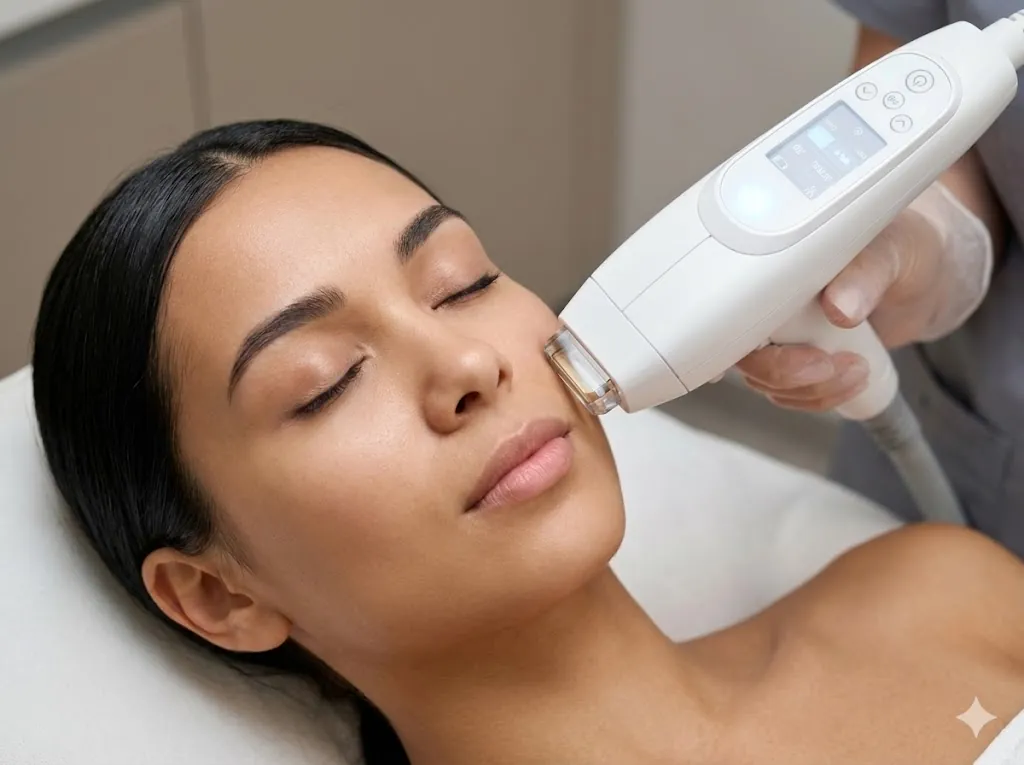
- Light pulses: The DPL handpiece delivers controlled pulses across treatment areas. You'll feel a warm "snap" — like a rubber band — with each pulse. Discomfort is commonly described as about 2-3/10
- Cooling: Integrated cooling in the handpiece keeps you comfortable throughout
- Duration: A full-face session takes approximately 20-30 minutes
That's it. You can literally do this during a lunch break and head right back to work.
After Your Treatment
Immediately after:
- Mild redness and warmth (like a light sunburn) — this typically fades within 2-4 hours
- Pigmented spots may temporarily darken (a good sign — the melanin is being brought to the surface)
- No open wounds, no peeling, no bandages
Days 1-7:
- Darkened spots begin to flake off naturally (do NOT pick!)
- Redness in treated vessels fades progressively
- Your skin may feel slightly dry — keep it moisturized
Days 7-14:
- The "wow" moment — pigmented spots have sloughed off, revealing clearer skin beneath
- Redness is noticeably reduced
- Skin tone appears more uniform and luminous
Days 14-30:
- Collagen remodeling continues, improving texture
- Full results from one session become apparent
- Time to schedule your next session for cumulative improvement
How Many Sessions Do You Need?
Improvement usually builds over a series of treatments:
| Concern | Typical Sessions | Interval |
|---|---|---|
| Mild sun spots | 2-3 sessions | 3-4 weeks apart |
| Moderate rosacea/redness | 3-5 sessions | 3-4 weeks apart |
| Broken capillaries | 2-4 sessions | 3-4 weeks apart |
| Comprehensive rejuvenation | 4-6 sessions | 3-4 weeks apart |
Results are cumulative — each session clears more pigment and more vascular damage. Maintenance sessions every 3-6 months are commonly used to keep skin clear and even.
DPL vs. Other Light Treatments: What Makes It Different?
DPL photofacial uses an optimized narrow band of light, offering a more targeted approach than traditional IPL while being more versatile than single-wavelength lasers.
| Feature | Traditional IPL | DPL Photofacial | Laser (e.g., Nd:YAG) |
|---|---|---|---|
| Wavelength range | Very broad | Optimized narrow band | Single wavelength |
| Versatility | High | High | Specific targets only |
| Downtime | Minimal | Minimal | May be moderate |
| Comfort | Moderate | Good (better cooling) | Varies |
| Sessions needed | 4-6 | 3-5 | 1-3 |
| Typically used for | General rejuvenation | Redness + pigment | Deep vessels |
DPL sits between the two: more targeted than traditional IPL, more versatile than single-wavelength lasers, and comfortable enough that numbing is usually not needed.
Who is DPL photofacial typically used for?
DPL is most often used for visible redness, rosacea, broken capillaries and sun damage in fair to medium-olive skin; a physician assessment decides whether it suits your skin. It is commonly considered by:
- Fitzpatrick skin types I-IV (fair to medium-olive skin tones respond best)
- Anyone with visible redness, rosacea, or broken capillaries
- People with sun damage or age spots they want to clear
- Those seeking overall skin tone improvement with little time away from daily life
- Clients who want a non-invasive alternative to more aggressive laser treatments
Important considerations:
- Very dark skin tones (Fitzpatrick V-VI) may need alternative treatments — we'll assess during your consultation
- Active acne breakouts should be treated first before DPL
- Pregnant or breastfeeding clients should wait until after
Can DPL be combined with other skin treatments?
Yes — depending on what a physician assessment finds, DPL is sometimes planned alongside RF microneedling, HydraFacial, skin boosters or medical-grade skincare. Treatments sometimes paired with DPL include:
- Sylfirm X — address deeper vascular concerns and skin laxity with RF microneedling
- HydraFacial — deep cleansing and hydration to complement your clearing treatments
- Skin boosters — inject hyaluronic acid for that glass-skin glow once your tone is even
- Medical-grade skincare — vitamin C serum and SPF to protect and maintain your results
Your consultation includes a personalized treatment plan tailored to your goals.
What do people ask most about DPL photofacial?
Q: Does DPL photofacial hurt? A: It is usually described as a warm snapping sensation — about a 2-3 out of 10 on the discomfort scale. The integrated cooling system keeps you comfortable throughout. No numbing is typically needed.
Q: How quickly will I see results? A: Pigmented spots begin darkening and flaking within 3-7 days. Redness improvement is progressive over 2-4 weeks. Noticeable improvement often appears after 2-3 sessions.
Q: Can I wear makeup after? A: We recommend waiting 24 hours before applying makeup to freshly treated skin. After that, you're free to resume your normal routine.
Q: How much downtime is there? A: Usually very little. You may have mild redness for a few hours and darkened spots for a few days, but neither prevents you from going about your normal life. Some people schedule treatments during a lunch break.
Q: How long do results last? A: Results from a full treatment series can last 6-12 months or longer, depending on your sun exposure and skincare habits. Maintenance sessions every 3-6 months keep results optimal.
Q: Can DPL help with my acne scars? A: DPL targets red acne marks (post-inflammatory erythema). Textured/indented acne scars respond to different mechanisms, such as microneedling or Sylfirm X; a physician assessment decides which combination suits your skin.
How do I book a DPL photofacial consultation in Burnaby?
Book a consultation online or call +1 (604) 639-2581. Skin Art MD is at #101 – 4378 Beresford St, Burnaby, near Metrotown, open Tuesday–Sunday 10:00–18:00. We'll analyze your skin, identify what's causing your concerns and, if DPL suits you, create a customized treatment plan.
Your filter-free era starts here.
Skin Art MD at Metrotown — Modern aesthetic medicine in Burnaby, BC. Serving Burnaby, Vancouver, New Westminster, Coquitlam, and Metro Vancouver.