What Is EMFace — And Why Does the Mechanism Matter?
EMFace is a non-invasive facial treatment that delivers two distinct energy modalities simultaneously: high-intensity focused electromagnetic stimulation (HIFES) to the facial musculature, and synchronized radiofrequency (RF) energy to the dermis and subdermal tissue.
It is used for non-invasive facial remodeling.
Most non-surgical facial technologies address the skin. EMFace is one of the few that directly targets facial muscle — a tissue layer that has historically been the domain of surgical SMAS repositioning.
Understanding why that matters requires a brief look at facial anatomy and how it changes with age. For a treatment overview, learn more about EMFace.
This article is the science layer for patients who want to understand the mechanism before booking.
Why Do Facial Muscles Matter for Facial Aging?
Facial muscles insert directly into the skin, so as they lose tone and volume with age, the skin above loses support — contributing to brow descent, midface flattening and less taut skin.
Facial muscles are anatomically distinct from skeletal muscles elsewhere in the body.
They insert directly into the dermis — meaning they physically support the skin above them. As these muscles lose tone and volume with age, the overlying soft tissue loses structural scaffolding.
The result is brow descent, midface flattening, and skin that appears less taut — not because the skin itself is necessarily damaged, but because the muscular support beneath it has diminished. This process is well-documented in craniofacial aging research.
Volume loss, skeletal resorption, and fat redistribution all contribute to the aged appearance — but muscular atrophy is a component that traditional non-surgical technologies have largely been unable to address.
How Does EMFace Work?
EMFace works through two pathways delivered together: HIFES triggers supramaximal facial muscle contractions that build muscle tone, and synchronized RF heats the dermis to stimulate new collagen and elastin.
HIFES — Supramaximal Facial Muscle Contraction
High-intensity focused electromagnetic stimulation works by inducing supramaximal muscle contractions — contractions that cannot be achieved through voluntary effort.
When electromagnetic pulses are applied transcutaneously at sufficient intensity, they depolarize motor neurons at a rate that exceeds what the central nervous system can generate on its own. These supramaximal contractions trigger two adaptive responses in muscle tissue:
- Hypertrophy — existing muscle fibers increase in cross-sectional area through increased protein synthesis
- Hyperplasia — satellite cells (the resident stem cells of muscle tissue) are activated, differentiate into myoblasts, and fuse with existing fibers, increasing the total number of functional fibers
At the signaling level, the mechanical stress of repeated supramaximal contraction activates the mTOR (mechanistic target of rapamycin) pathway, a master regulator of muscle protein synthesis. This is the same adaptive signaling triggered by resistance exercise, but at an intensity and rate that voluntary contraction cannot match — and applied to the thin, skin-inserting muscles of the face that do not respond to conventional exercise.
Synchronized RF — Dermal Remodeling and Neocollagenesis
The RF component of EMFace operates via resistive heating: radiofrequency energy causes ionic oscillation within tissue, generating heat from within the dermis rather than from a surface source. When dermal temperature is raised to the therapeutic window (approximately 40–45°C), a cascade of tissue responses is initiated:
- Immediate collagen contraction — Existing collagen fibers partially denature and contract, contributing to an early tightening effect visible after initial sessions.
- Neocollagenesis — Thermal stimulation activates fibroblasts, upregulating production of Type I and Type III collagen over the weeks following treatment. This is the primary mechanism behind results that continue to develop after the treatment course ends.
- Elastin remodeling — Fibroblast activation also drives elastin synthesis, improving skin elasticity.
- Heat shock protein upregulation — HSP47 and related chaperone proteins are upregulated, facilitating organized collagen deposition rather than disorganized scar-like fibrosis.
The synchronization of RF with HIFES is a key architectural feature of the EMFace platform. Simultaneous delivery may enhance the distribution and thermal consistency of RF energy by modulating local tissue geometry and perfusion dynamics during muscle contraction — though the precise cellular interaction of the dual-modality synchronization remains an active area of research.
What Does the Clinical Evidence Show?
The studies summarized below report increased facial muscle thickness, histological signs of new collagen and no serious adverse events, although some published EMFace studies involved the manufacturer in their design.
Muscle Density and Facial Lift
Weiss et al., publishing in the Journal of Cosmetic Dermatology, evaluated EMFace outcomes in subjects receiving four treatment sessions over four weeks.
High-frequency ultrasound imaging was used to quantify changes in facial muscle thickness before and after the protocol. The study demonstrated statistically significant increases in muscle thickness in treated areas, with blinded photographic assessments showing improvement in brow position and midface lift.
The study also reported subject-rated improvement in facial contour.
Histological Confirmation of Collagen Remodeling
Gold et al., writing in the Aesthetic Surgery Journal, published biopsy-confirmed histological data from patients treated with synchronized RF combined with HIFES.
Biopsies taken at baseline and at defined post-treatment intervals showed measurable increases in collagen fiber density and organizational regularity within the reticular dermis. Critically, the collagen architecture observed post-treatment was consistent with newly synthesized collagen — supporting the neocollagenesis hypothesis rather than attributing results solely to acute thermal contraction of pre-existing fibers.
Safety Profile and Adverse Event Analysis
Kilmer et al., in a safety review published in Lasers in Surgery and Medicine, examined the adverse event profile of combined HIFES and RF in facial applications across a multi-center cohort. No serious adverse events were documented.
Observed side effects were limited to transient mild erythema and warmth lasting 30–60 minutes post-session. No burns, prolonged edema, or structural adverse events were recorded. This safety profile supports the non-ablative energy delivery model of the device.
It is worth noting that a portion of published EMFace studies include manufacturer involvement in study design. However, the use of objective outcome measures — ultrasound imaging, histological biopsy, validated grading scales — rather than relying solely on subjective photography strengthens the evidentiary value relative to studies using only global aesthetic improvement scales.
How Does EMFace Compare With Other Non-Invasive Treatments?
EMFace uses HIFES and synchronized radiofrequency to target both muscle and dermis, specifically toning muscle rather than relaxing it.
| Treatment | Primary Mechanism | Target Tissue | Addresses Muscle? | Downtime |
|---|---|---|---|---|
| EMFace | HIFES + synchronized RF | Muscle + dermis | Yes (tones) | Same-day return typical |
| Ultherapy (HIFU) | High-intensity focused ultrasound | SMAS + deep dermis | No | Minimal |
| Thermage | Monopolar RF | Dermis + subdermal | No | Same-day return typical |
| Sculptra | Poly-L-lactic acid biostimulator | Subdermal/dermis | No | Minimal; temporary swelling possible |
| Neuromodulators | Acetylcholine blockade | Neuromuscular junction | Relaxes (not tones) | Same-day return typical |
| Surgical facelift | Mechanical SMAS repositioning | All layers | Indirectly | Significant |
The key clinical distinction of EMFace is dual-pathway tissue addressing — muscle and dermis simultaneously — and specifically its effect on muscle tone (hypertrophy) rather than muscle relaxation, as neuromodulators produce. This makes EMFace conceptually complementary to injectable treatments in a combination protocol rather than a competing alternative.
Compared to HIFU technologies such as Ultherapy, EMFace operates at shallower tissue depths and does not target the SMAS layer directly. HIFU is generally discussed for more significant skin laxity requiring deeper structural repositioning, while EMFace is discussed for muscular toning and early-to-moderate dermal tightening with a more comfortable treatment profile. Book a Consultation to find out which modality or combination, if any, is suitable for your anatomy and goals.
Who Is EMFace Usually Considered For?
EMFace is generally discussed for adults with early-to-moderate facial aging linked to reduced muscle support, and a physician assessment of anatomy, skin quality and laxity decides suitability.
At Skin Art MD in Burnaby, EMFace candidacy is assessed by a physician. Candidacy for EMFace is not a binary yes/no — it requires evaluating facial anatomy, skin quality, degree of laxity, and what the patient is actually trying to achieve.
Profiles Where EMFace Is Commonly Discussed
EMFace is generally discussed for people who:
- Are in the 30–65 age range with early-to-moderate signs of facial aging
- Present with brow ptosis or forehead heaviness related to frontalis muscle laxity rather than structural skeletal descent
- Have midface flattening attributable to reduced muscular support — not primarily to fat loss or volume deficit
- Show skin laxity in the range addressable by dermal remodeling, without severe gravitational descent
- Are at or near a stable weight, as significant fluctuation can affect facial soft tissue volume
- Have realistic expectations about non-surgical outcomes — meaningful improvement, not surgical transformation
Patients for Whom EMFace May Not Be the Right Primary Intervention
- Severe skin laxity with significant gravitational descent — surgical approaches or deep HIFU may be more appropriate
- Significant facial volume deficit — structural biostimulators, fat grafting, or filler may address the root cause more directly
- Patients who primarily seek improvement of dynamic wrinkles — neuromodulators remain the standard of care for this indication
- Patients with predominantly bony facial aging (skeletal resorption, orbital rim recession) — volume restoration is the correct primary strategy
Who Should Not Have EMFace, and What Can't It Do?
EMFace is not used with implanted electronic devices, metal hardware near the face, pregnancy or active malignancy in the area, and it cannot reposition significantly descended tissue or replace lost volume.
Absolute Contraindications
- Electronic implanted devices: cardiac pacemakers, implantable cardioverter-defibrillators (ICDs), cochlear implants, deep brain stimulators, or any active neurostimulator device
- Metal hardware in or near the facial treatment zones
- Active pregnancy
- Active malignancy in or near the treatment area
Relative Contraindications and Cautions
- Active inflammatory dermatoses, active herpes simplex outbreaks, or cutaneous infections in the treatment zone
- Recent facial surgery — timing of post-operative EMFace treatment requires physician evaluation
- Patients with unrealistic expectations for non-surgical outcomes
What EMFace Cannot Do
Honest candidate counseling requires clarity about what the treatment does not address:
- EMFace cannot reposition significantly descended tissue — that is a surgical task
- EMFace does not replace volume loss — a separate intervention is required for patients with significant lipoatrophy or bony resorption
- Results are gradual and develop over weeks; patients seeking dramatic, rapid change may be better served by a different conversation about their goals
What Happens During an EMFace Treatment Course?
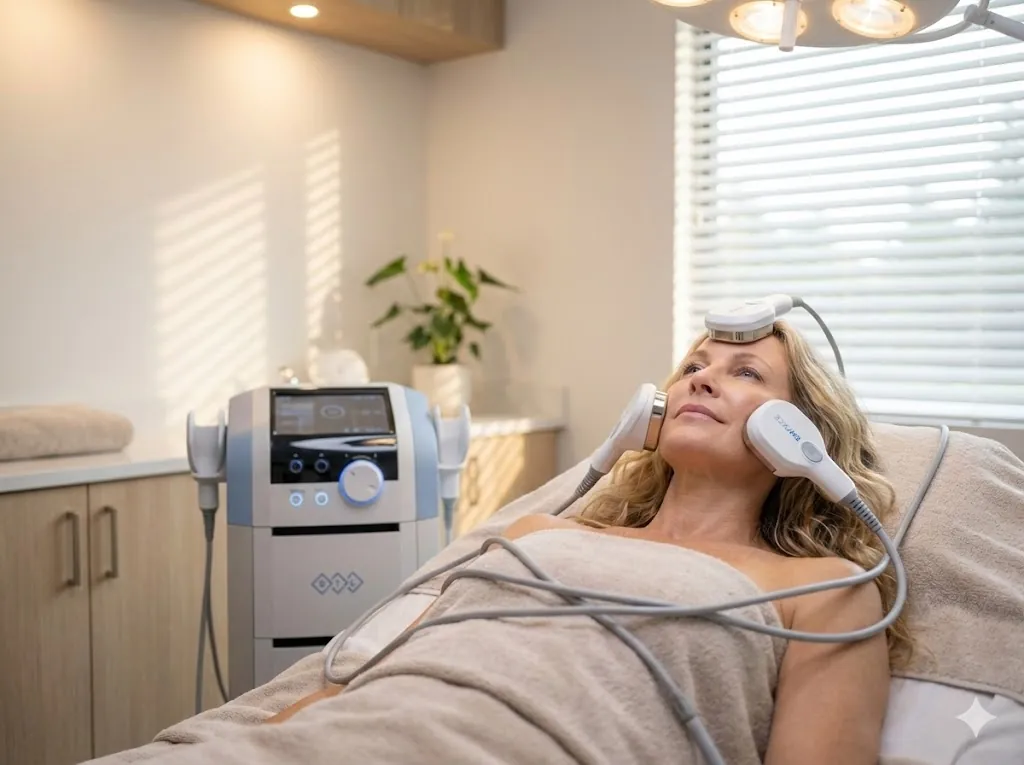
A standard EMFace course consists of four sessions, each approximately 20 minutes, conducted at weekly intervals.
Three applicators are placed — one on the forehead, two on the cheeks — held in position with a conductive gel interface. No anesthesia is required.
The sensation is typically described as a warm, rhythmic pulling or tapping — distinct from the sharper discomfort sometimes associated with HIFU. Most people return to their regular activities the same day.
Some mild erythema lasting 30–60 minutes post-session is common. This resolves spontaneously.
Results develop gradually:
- Early changes in skin texture may be visible after sessions 2–3
- Muscular hypertrophy and full collagen remodeling outcomes are typically visible 4–12 weeks after the final session
- Maximum improvement is generally observed at the 12-week post-treatment mark
Maintenance protocols vary by patient but typically involve a single session every 3–6 months to sustain outcomes over time.
How Does Skin Art MD in Burnaby Approach EMFace?
At Skin Art MD, EMFace is considered only after a full facial assessment, and a physician decides whether it — alone, in combination, or not at all — is suitable.
- Physician-led evaluation. Facial musculature, skin quality, volume distribution and laxity are assessed before any recommendation; EMFace is suggested only when it fits your presentation.
- Combination planning. EMFace can be sequenced with neuromodulators, biostimulators or other injectables when more than one aging mechanism is involved, planned by a physician.
- Bilingual care. Consultations are available in both English and Mandarin Chinese, so goals, concerns and medical history can be discussed in your preferred language.
- Located in Burnaby. The clinic is in the Metrotown area and accessible from across Metro Vancouver.
Book a Consultation — available in English and Mandarin.
What Do People Ask About EMFace?
Common questions cover the number of sessions, comfort, how long results last, combining EMFace with injectables, who is not a candidate, how it compares with Ultherapy, and cost.
How many EMFace sessions are needed? The standard protocol is four sessions, each approximately 20 minutes, at weekly intervals. Results continue to develop for up to 12 weeks after the final session as collagen remodeling and muscular adaptation progress.
Is EMFace painful? It is usually described as a warm, rhythmic pulling or tapping sensation. It is generally well-tolerated without anesthesia and is considered more comfortable than HIFU-based treatments.
How long do results last? Individual results vary. Clinical data suggests results can be maintained for approximately 6 months or more, with maintenance sessions typically recommended every 3–6 months.
Can EMFace be combined with neuromodulator injections or dermal fillers? Yes. EMFace and neuromodulators address fundamentally different mechanisms — muscle toning versus selective muscle relaxation — making them complementary. The sequencing of combination treatments should be planned by a physician.
Who is not a candidate for EMFace? Patients with electronic implants (pacemakers, cochlear implants, neurostimulators), metal hardware near the treatment zone, active pregnancy, or active skin infections in the treatment area are not candidates. Physician evaluation is required to confirm suitability.
How does EMFace compare to Ultherapy? Ultherapy uses high-intensity focused ultrasound to target the SMAS layer and deep dermis. EMFace uses HIFES and synchronized RF to address facial musculature and the reticular dermis. They target different depths and tissue types — the suitable choice depends on your anatomy, degree of laxity, and treatment goals.
How much does EMFace cost at Skin Art MD? Contact us for current pricing. Treatment costs depend on your protocol design and any combination treatments included in your personalized plan.
How Do I Book an EMFace Consultation in Burnaby?
You can book a consultation at Skin Art MD in Burnaby, where the medical team assesses your facial anatomy and goals, and a physician assessment decides whether EMFace or another option is suitable.
Book a consultation — available in English and Chinese.
This article is for educational purposes only and does not constitute medical advice. Please consult with a qualified healthcare professional before undergoing any treatment.