Exosome Hair Therapy: The Science Explained
Hair loss affects millions of Canadians — and for many, the emotional weight is as significant as the physical change. If you have been researching solutions, you may have encountered exosome hair therapy: one of the most mechanistically compelling approaches in regenerative medicine today. This article is a science deep-dive — not a sales page. It explains exactly how exosome-based hair restoration works, what the peer-reviewed evidence shows, and whether you might be a suitable candidate.
Learn more about Exosome Hair Therapy
What Are Exosomes? The Biology of Cellular Messaging
Exosomes are extracellular vesicles — nanoscale membrane-bound packages ranging from 30 to 150 nanometers in diameter — secreted by virtually every cell type in the human body. They function as biological communication tools: transferring proteins, lipids, messenger RNA (mRNA), microRNA (miRNA), and growth factors from donor cells to recipient cells across tissues.
Unlike stem cells themselves, exosomes are acellular. They carry the signals that stem cells use to coordinate tissue repair and regeneration, without introducing living donor cells into the recipient's body. This distinction matters clinically: it reduces immunogenicity risk and simplifies regulatory handling compared to cell-based therapies.
In hair restoration, exosome preparations are typically derived from mesenchymal stem cells (MSCs) — most commonly sourced from bone marrow or Wharton's jelly (umbilical cord tissue). MSC-derived exosomes are exceptionally rich in growth factors and signaling molecules relevant to follicle biology, making them a scientifically logical tool for addressing hair loss at the root level.
Mechanism of Action: How Exosomes Drive Hair Growth
To understand how hair growth exosomes work, we need to examine the hair follicle cycle. Each follicle moves through three phases:
- Anagen — active growth, lasting 2–7 years
- Catagen — transition phase, lasting 2–3 weeks
- Telogen — resting and shedding phase, lasting approximately 3 months
In androgenetic alopecia (the most common form of pattern hair loss in both men and women), follicles progressively miniaturize over repeated cycles. The anagen phase shortens, hair diameter decreases, and eventually the follicle becomes dormant. MSC-derived exosomes intervene at multiple points in this cascade.
Growth Factor Delivery and Angiogenesis
Exosomes carry elevated concentrations of vascular endothelial growth factor (VEGF), which promotes angiogenesis — the formation of new capillary networks around follicles. Improved microvascularization means follicles receive better nutrient and oxygen delivery, a critical requirement for sustaining the metabolically demanding anagen phase. A follicle starved of blood supply cannot maintain active growth regardless of what other signals are present.
Wnt/β-Catenin Pathway Activation
The Wnt signaling pathway is one of the master regulators of the hair cycle. Exosomal miRNAs and proteins have been demonstrated to upregulate Wnt/β-catenin signaling in dermal papilla cells — the specialized mesenchymal cells at the base of each follicle that orchestrate cycling. Activation of this pathway promotes telogen-to-anagen transition, effectively pushing dormant follicles back toward active growth.
Anti-Inflammatory and Anti-Apoptotic Effects
Chronic, low-grade follicular inflammation is now recognized as a co-driver of androgenetic alopecia and other forms of hair thinning. Exosomes carry anti-inflammatory cargo — including TGF-β isoforms and interleukin-10 precursors — that modulate the follicular microenvironment and reduce inflammatory damage to the dermal papilla. This protective effect may help preserve follicle viability over time.
Fibroblast Growth Factor Signaling
FGF-7 (keratinocyte growth factor) and FGF-10, delivered exosomally, directly stimulate keratinocyte proliferation — the cells responsible for forming the hair shaft. This supports thickening of existing strands and may contribute to extending the anagen phase duration.
The net effect is a multi-pathway regenerative signal that works with the follicle's own biology rather than suppressing a single hormonal pathway. This is fundamentally different from pharmacological approaches like finasteride, and complementary to them.
Clinical Evidence: What the Research Shows
Regenerative hair therapy using exosomes is a rapidly evolving field, and the peer-reviewed evidence base is expanding. Below is a summary of key studies informing current clinical practice.
Rajendran et al., published in the International Journal of Molecular Sciences, examined the role of MSC-derived extracellular vesicles in hair follicle regeneration. The researchers found that exosomal cargo — particularly miR-21 and miR-146a — significantly promoted dermal papilla cell proliferation and migration in vitro. Treated follicles in murine models demonstrated accelerated transition from telogen to anagen, supporting the mechanistic hypothesis that exosomal miRNA delivery can functionally reprogram follicle cycling.
Hu et al., in the Journal of Dermatological Science, conducted a preclinical investigation of Wharton's jelly MSC-derived exosomes applied to alopecia models. Treated subjects demonstrated measurable increases in follicle density and hair shaft diameter compared to controls. The authors identified VEGF upregulation as a primary mechanism, consistent with the angiogenesis hypothesis of exosome action in the scalp.
Kwon et al., in Stem Cells Translational Medicine, reported outcomes from a controlled study of human dermal papilla cell response to exosome treatment. They found significant increases in proliferation-related gene expression — including cyclin D1 and β-catenin — alongside elevated VEGF secretion from treated cells. The study supports the hypothesis that exosomes can reprogram aged or dormant papilla cells toward a more active, growth-supporting state.
Collectively, this body of work provides a compelling mechanistic rationale for exosome-based hair therapy. Large-scale randomized controlled trials in humans are an active area of ongoing research, and clinical protocols at evidence-based clinics like SkinArtMD are updated as new peer-reviewed data emerges.
Book a Consultation to discuss whether exosome hair therapy fits your specific pattern of hair loss.
Exosome Therapy Compared to Adjacent Treatments
| Treatment | Mechanism | Invasiveness | Key Targets | Notes |
|---|---|---|---|---|
| Exosome Hair Therapy | Multi-pathway regenerative signaling via extracellular vesicles | Low (scalp injection or microneedling) | Dermal papilla, angiogenesis, Wnt pathway | Acellular; standardized growth factor payload |
| PRP (Platelet-Rich Plasma) | Autologous growth factor delivery | Moderate (blood draw + injection) | VEGF, PDGF, EGF pathways | Growth factor concentration depends on individual platelet health |
| Minoxidil | Vasodilation; prolongs anagen phase | None (topical or oral) | Potassium channel opening | Health Canada and medical-grade; requires ongoing use |
| Finasteride | DHT reduction via 5-alpha reductase inhibition | None (oral) | Androgen pathway | Health Canada and medical-grade; primarily targets androgenetic pattern |
| Hair Transplant Surgery | Surgical redistribution of DHT-resistant follicles | High (surgical) | Permanent follicle relocation | Best for candidates with stable donor supply |
Exosomes vs. PRP: PRP relies on your own platelet-derived growth factors — effective, but the concentration varies with individual platelet count and health status. Exosomes deliver a standardized, high-concentration payload of regenerative signals regardless of the patient's baseline platelet profile. Because exosome preparations are acellular, they also bypass the cell viability concerns inherent in any autologous cellular approach.
Exosomes vs. finasteride: Finasteride targets one pathway — androgen-mediated miniaturization — and is most effective in specific genetic patterns. It slows further loss rather than regenerating follicles. Exosome therapy targets the follicle regeneration biology more directly. Many candidates benefit clinically from a combined approach, and this is something our physician team evaluates individually.
Candidate Evaluation: Who Is Most Likely to Benefit?
Candidate evaluation at SkinArtMD begins with a thorough consultation with our physician team. Dr. Sharon Fong, a CPSBC-registered physician specializing in aesthetic medicine and regenerative treatments, leads candidate assessments to ensure each patient receives a protocol matched to their clinical picture — not a one-size-fits-all protocol.
Exosome hair therapy is generally most appropriate for individuals who:
- Are experiencing early to moderate androgenetic alopecia (Norwood Scale I–IV for men; Ludwig Scale I–II for women)
- Have active but miniaturizing follicles — follicular infrastructure must still be partially intact for regenerative signals to have meaningful targets
- Have tried first-line pharmacological options without sufficient results, or prefer a regenerative approach
- Are seeking to complement a hair transplant — exosomes are increasingly used peri-procedurally to support graft survival and accelerate recovery
- Are in good general health without active scalp pathology
Patients often tell us they wish they had started treatment earlier — which aligns with the evidence: regenerative therapies demonstrate the strongest results when follicular reserve is still present. Many of our clients across Greater Vancouver, including from Burnaby and the surrounding Metrotown area, come to us having tried topicals without satisfying results and are now seeking a more targeted biological approach.
Limitations and Contraindications
As with any medical treatment, exosome hair therapy is not universally appropriate. Contraindications and limiting factors include:
- Active scalp infections (bacterial, fungal, or viral) — must be fully resolved before treatment
- Autoimmune alopecia (alopecia areata, alopecia totalis) — evidence base is less established; outcomes are less predictable and require careful individual assessment
- Scarring alopecia (lichen planopilaris, frontal fibrosing alopecia) — once follicular architecture is replaced by fibrous tissue, regenerative signals have diminished targets
- Active scalp malignancy or recent head/neck radiation — absolute contraindication
- Pregnancy and breastfeeding — treatment is deferred; safety data in this population is not established
- Active immunosuppressive therapy — relative contraindication requiring physician assessment
- Advanced hair loss (Norwood VI–VII, Ludwig III) — severely depleted follicular reserve limits the biological targets available for regenerative response
On regulatory context: In Canada, Health Canada classifies exosome-based biologics under evolving regulatory guidance. Our clinical team at SkinArtMD sources products exclusively through regulated supply chains and operates fully within current Health Canada guidance. We do not use unverified grey-market preparations.
On expectations: Visible results develop over 3–6 months as follicles complete anagen cycles. Individual results depend on degree of loss, follicular reserve, genetics, and adherence to any co-prescribed therapies. This is a treatment that supports and amplifies biology — not an overnight transformation.
Treatment Protocol: Step by Step
At SkinArtMD in Burnaby, exosome hair therapy follows a structured, physician-designed protocol:
- Consultation and assessment — scalp examination, clinical history review, and baseline photography for objective tracking
- Scalp preparation — cleansing and topical anesthetic application for comfort
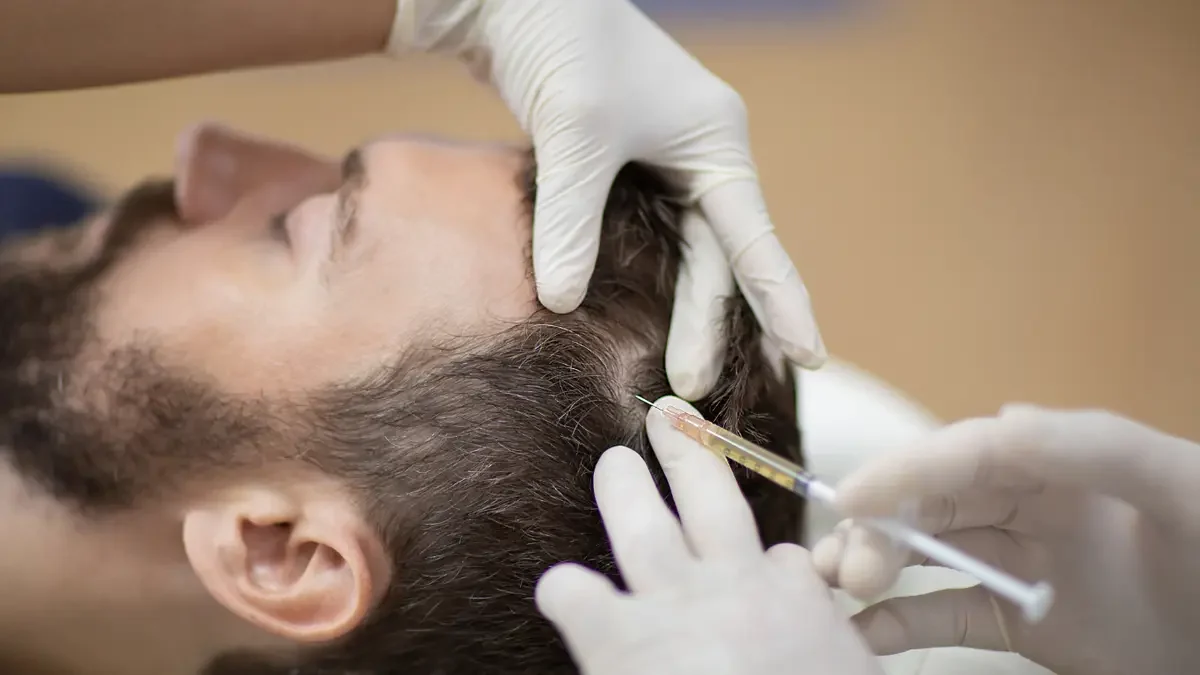
- Exosome delivery — via micro-injections at the follicular level, microneedling with exosome solution, or a combined approach depending on the protocol selected
- Post-treatment care — avoid harsh shampoos, heat styling, and heavy scalp products for 24–48 hours; detailed aftercare instructions provided
- Initial series — typically 3–4 sessions spaced 4–6 weeks apart
- Maintenance — periodic sessions every 6–12 months to sustain follicular support
Sessions require no significant downtime. Mild scalp sensitivity or transient redness for a few hours post-treatment is the most commonly reported response.
Why Choose SkinArtMD for Exosome Hair Therapy?
SkinArtMD is a physician-led medical aesthetics clinic committed to evidence-based care. Here is what differentiates our approach:
- Physician oversight at every step: Every protocol is designed and supervised by our licensed medical team. You are not receiving care from a non-medical provider making autonomous treatment decisions.
- Regulated product sourcing: We use exosome preparations from compliant, Health Canada-aligned manufacturers — never unverified grey-market products.
- Personalized treatment plans: No two patients share the same pattern of hair loss, baseline follicular reserve, or treatment goals. Our protocols reflect individual clinical pictures.
- Bilingual care: Our team serves patients in both English and Mandarin Chinese — making detailed medical conversations comfortable and accurate for our diverse Greater Vancouver patient community.
- Integrated approach: Where appropriate, our team can coordinate exosome therapy with topical treatments, nutritional support, or PRP through a single care team — no fragmented care across multiple providers.
Many of our clients from Burnaby and the broader Greater Vancouver area tell us that the physician-led model gave them confidence they hadn't found at other aesthetics clinics. That standard of care is non-negotiable for us.
Frequently Asked Questions
Q: How many sessions will I need? A: Most patients begin with an initial series of 3–4 sessions spaced 4–6 weeks apart, followed by periodic maintenance sessions every 6–12 months. Your physician will outline a specific plan based on your pattern of loss and treatment response.
Q: Is exosome hair therapy painful? A: Discomfort is typically mild. Topical anesthetic is applied prior to treatment. Patients describe the injections as a brief pinching sensation. Most people tolerate the procedure easily and return to normal activities the same day.
Q: How soon will I see results? A: Hair follicle biology means visible results take time. Most patients begin to notice improvements in density and texture at the 3–4 month mark, with more meaningful changes visible at 6 months. Baseline and follow-up photography helps track progress objectively.
Q: Can I combine exosome therapy with finasteride or minoxidil? A: Yes — in many cases, a combined approach is clinically appropriate. Finasteride addresses androgen-driven miniaturization; exosomes address regenerative biology. Your physician will determine whether combination therapy is right for your specific situation.
Q: Are exosomes safe? A: MSC-derived exosomes have a favorable safety profile based on current evidence. Because they are acellular, they do not carry the risks associated with cell-based transplants. As with any injectable treatment, minor procedural risks (localized discomfort, temporary redness) exist. All treatments at SkinArtMD are performed under physician supervision.
Q: How much does exosome hair therapy cost? A: Contact us for current pricing. Pricing reflects your individualized protocol, number of sessions, and product concentration. We discuss cost transparently during your consultation with no hidden fees.
Next Steps
If you have been researching exosome hair therapy and want to understand whether your pattern of hair loss and current follicular reserve make you a strong candidate, the next step is a personalized physician consultation. Our team at SkinArtMD in Burnaby can assess your scalp, review your clinical history, and outline a realistic, evidence-grounded treatment plan tailored to you.
Book a Consultation — available in English and Mandarin Chinese.
Ready to See What Exosome Hair Therapy Can Do for You?
Our medical team at SkinArtMD in Burnaby is ready to create your personalized treatment plan. Book your complimentary consultation today — available in English and Chinese.
This article is for educational purposes only and does not constitute medical advice. Please consult with a qualified healthcare professional before undergoing any treatment.