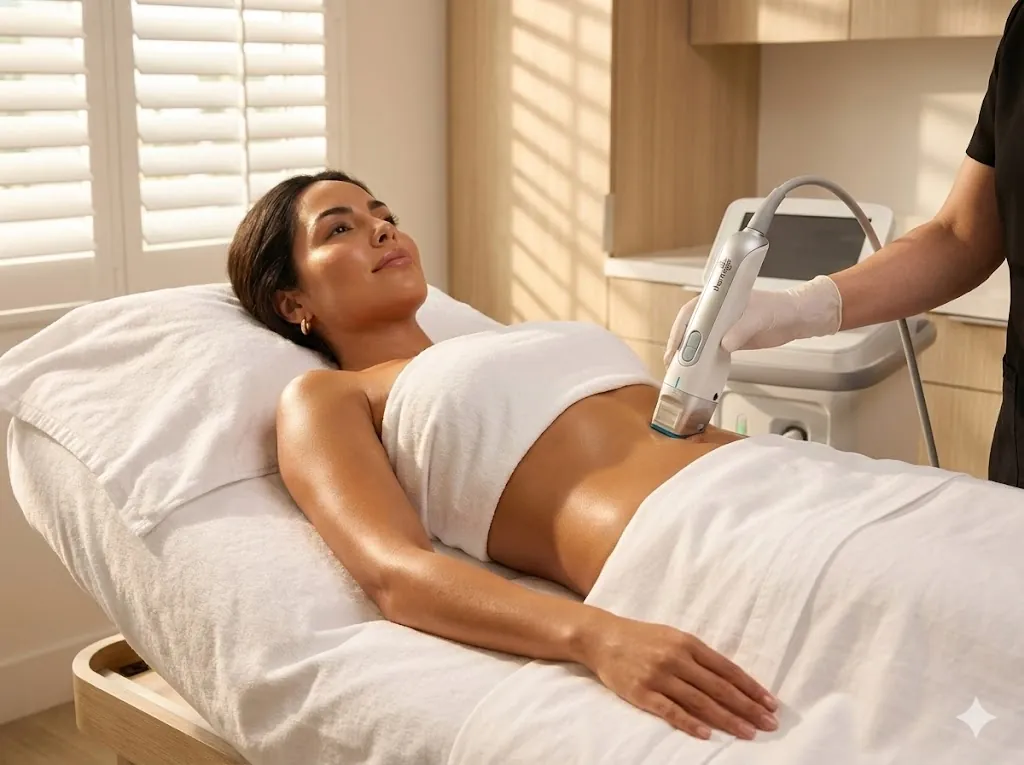
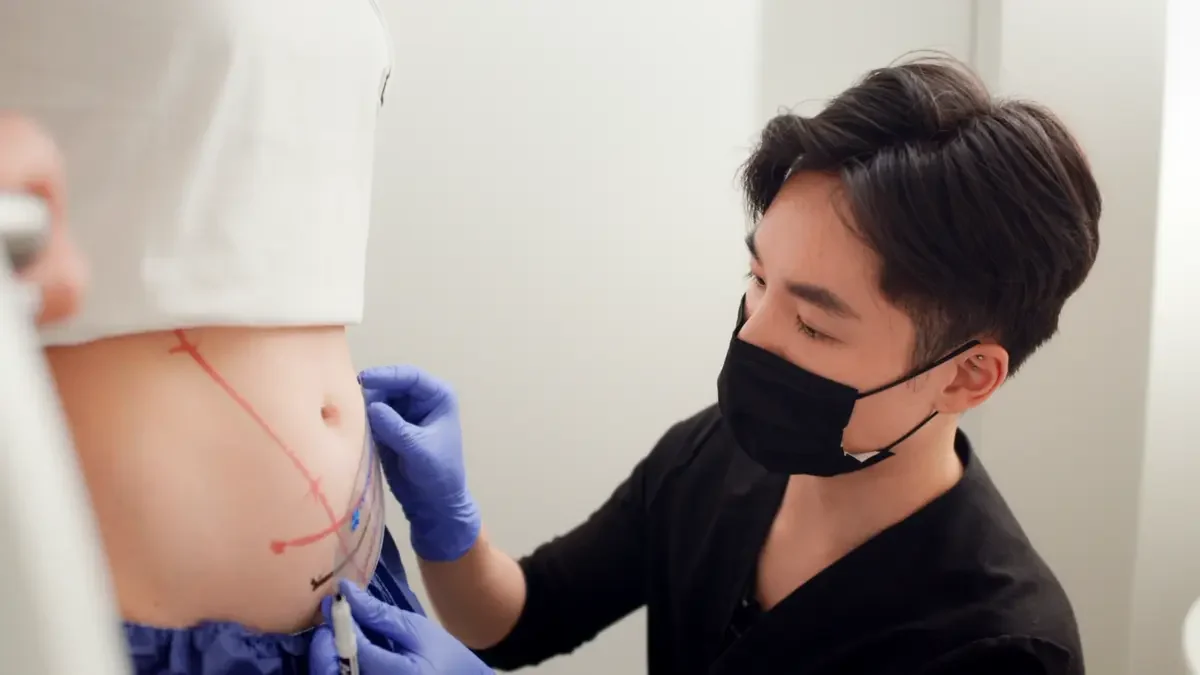
PicoWay Body uses very short picosecond pulses that act mainly as a photoacoustic shockwave on pigment rather than a prolonged heat load. The physician selects one of three wavelengths to match the target, and at Skin Art MD in Burnaby it is discussed for sun spots, scars and stretch marks, with a physician assessment deciding suitability.
What is PicoWay Body and how does it differ from facial treatment?
PicoWay Body is a picosecond laser approach applied to body areas such as the hands, arms, chest and back, where skin is thicker and heals more slowly than on the face. It uses a picosecond laser on those areas, and very short pulses act mainly through a photoacoustic effect. The physician picks 532, 785 or 1064 nm to match the target. At Skin Art MD in Burnaby, it is discussed for sun spots, scars and stretch marks, and a physician assessment decides suitability.
The main difference from facial treatment is the planning around the skin itself. Body skin is thicker and heals more slowly than facial skin, so settings and aftercare are planned for the area rather than carried over from a face protocol. The face version has its own page, and tattoo removal is covered on the Tattoo Removal page.
- Area: hands, arms, chest, back, abdomen and hips, confirmed at consultation
- Wavelength: chosen for the target, not a fixed setting
- Aftercare: tailored to slower body-skin healing and sun protection
More detail on the approach is available on the PicoWay Body page.
What is the mechanism of action at the cellular level?
The device delivers pulses of a trillionth of a second, so pigment is broken up by a photoacoustic shockwave rather than by a long heat exposure. That distinction matters on body skin, where the target often sits deeper and the surrounding tissue has more of it.
- Pulse duration (F28): Pulses of a trillionth of a second act as a shockwave on pigment rather than a prolonged heat load. The pigment particles fracture into smaller fragments, which the body then clears gradually over the following weeks.
- Wavelength selection (F10): PicoWay Body uses a picosecond laser on areas such as the hands, arms, chest and back, and the physician picks 532, 785 or 1064 nm to match the target.
- Absorption profile (F20): Different pigments absorb different wavelengths. PicoWay offers three, so the physician can match energy to the target and the depth.
Because the energy is delivered so briefly, the mechanism is largely mechanical rather than thermal, which is why the surrounding skin is spared a sustained heat load. For scars and stretch marks, sub-surface picosecond energy is discussed for texture on the back, shoulders and abdomen. A physician assessment at Skin Art MD in Burnaby decides suitability, and more detail sits on the PicoWay Body page.
How do the three wavelengths fit different targets?
Different pigments absorb different wavelengths, so three options let the physician match energy to the target and its depth instead of using one fixed setting. PicoWay Body offers 532, 785 and 1064 nm, and each is discussed for a different job.
- 1064 nm penetrates deepest and is absorbed by dark pigment, delivering less heat in melanin-rich skin.
- 785 nm is suited to blue and green targets.
- 532 nm is suited to superficial pigment and red or orange targets.
That range matters because body pigment is not one thing. Sun spots on the hands, arms and chest sit closer to the surface, where 532 nm is typically considered. Sub-surface picosecond energy is discussed for the texture of scars and stretch marks on the back, shoulders and abdomen, where deeper delivery may be relevant. The very short pulses act as a shockwave on pigment rather than a prolonged heat load, and wavelength choice is what directs that effect.
Matching wavelength to target matters more than raw power. At Skin Art MD, a physician-led clinic in Burnaby, BC, the wavelength is chosen for the target rather than a fixed setting, and a physician assessment decides suitability.
What does the clinical evidence summary show for picosecond lasers?
Peer-reviewed literature describes picosecond-domain lasers as acting through photomechanical effects on pigment and as being studied for pigmentary and scar-related concerns, though individual outcomes vary by area and target. Smith et al., in JAAD, characterised picosecond pulses as delivering energy in pulses of a trillionth of a second, so pigment is broken up by a shockwave rather than a prolonged heat load — the same principle described for PicoWay Body at Skin Art MD in Burnaby. Chan et al., writing in Lasers in Surgery and Medicine, examined picosecond treatment in the context of pigmentary concerns, where wavelength choice and target depth shape the plan. Bernstein et al., in Dermatologic Surgery, reported on picosecond lasers for scar-related concerns, a use that remains hedged: texture may change gradually across a series, and results vary by area and scar type.
Two practical points follow from this literature. First, matching the wavelength to the target matters more than raw power, which is why the physician selects among 532, 785 and 1064 nm rather than using a fixed setting. Second, body skin is thicker and heals more slowly than facial skin, so settings and aftercare are planned for the area.
A physician assessment at Skin Art MD decides suitability; the clinic's medical director is Dr. Charles Jiang, a licensed physician in British Columbia.
How does PicoWay compare with adjacent mechanisms such as PicoSure Body?
PicoSure Body is another picosecond body option, and the practical difference lies in wavelength options and how the physician matches them to the target rather than in a claim that one system is superior. Both work on the same principle: pulses of a trillionth of a second act as a shockwave on pigment rather than a prolonged heat load. The distinction is in the menu of wavelengths available for planning.
PicoWay offers three wavelengths — 532, 785 and 1064 nm — and this range is what allows the physician to match the target rather than use a single setting. Different pigments absorb different wavelengths, so the choice is made against the depth and colour of what is being treated:
- 532 nm for superficial pigment and red or orange targets
- 785 nm for blue and green targets
- 1064 nm, which penetrates deepest and is absorbed by dark pigment while delivering less heat in melanin-rich skin
That flexibility matters on body skin, where hands, chest, back and abdomen present different targets and different healing behaviour. Matching wavelength to target matters more than raw power, and at Skin Art MD in Burnaby the plan sits inside a physician-led clinic at Metrotown, where a physician assessment decides suitability.
Who is assessed as a candidate, and who may be advised to wait?
A physician assessment at Skin Art MD decides suitability by reviewing skin type, the area and history, and some circumstances call for delaying treatment. The consultation is the point where a general interest in PicoWay Body becomes a plan for a specific patch of skin.
Concerns commonly raised for body treatment include sun spots and age spots on the hands, arms and chest; acne scars on the back, shoulders or chest; stretch marks and surgical scars; and uneven pigment on the body. None of these is automatically suitable, and the assessment weighs the target against the surrounding skin.
Reasons a physician may advise waiting:
- Pregnancy or breastfeeding
- Skin infection or open wounds in the area
- A history of keloid scarring, assessed case by case
- A recent tan, since treatment is usually delayed about four weeks
- An active cold sore, rash or eczema flare in the area
- Isotretinoin in the past 6 months, or a light-sensitising medication
Plans sit within the care of the clinic's medical director, Dr. Charles Jiang, a licensed physician in British Columbia. Suitability for each body area is confirmed at consultation, and the wavelength is chosen for the target rather than a fixed setting.
What happens during a PicoWay Body visit, and what aftercare follows?
A session begins with wavelength selection, typically runs 30 to 60 minutes depending on the area, and ends with cooling and a written aftercare plan. Preparation starts earlier: sun and tanning on the area are avoided for about four weeks, retinoids and exfoliants are paused for about a week, and the clinic is told about medications, pregnancy and recent procedures. Skin should arrive clean and product-free.
During the session, eyewear is fitted, the area is cleansed and the wavelength is confirmed. Picosecond pulses are then delivered across the area, which may feel like a snapping sensation. Cooling is applied afterwards, and written aftercare is provided. The next session is planned once the skin has settled, often about 4 to 6 weeks later for pigment.
Aftercare reflects the fact that body skin heals more slowly than facial skin, so a tailored plan and sun protection are provided. Redness and mild swelling are common for a day or two, and treated pigment can darken and flake for about a week. Keeping the area moisturized and using broad-spectrum sunscreen for several weeks matters. Temporary lighter or darker patches can occur, more often in darker skin; they usually fade but can rarely persist. Less often, blisters or scabs form and should heal without picking. A physician assessment at Skin Art MD in Burnaby decides suitability.
What are the limitations, side effects and expected results?
Redness, mild swelling and temporary pigment darkening are common, results build gradually across a series, and some risks are higher in darker skin.
Most reactions settle quickly. Redness and mild swelling typically last a day or two, and treated pigment can darken and flake for about a week before clearing. Keeping the area moisturized and protected from sun supports healing, and broad-spectrum sunscreen on treated areas for several weeks is part of the plan.
Some effects need more attention:
- Temporary lighter or darker patches can occur, more often in darker skin; they usually fade but can rarely persist.
- Less often, blisters or scabs form; these should heal without picking.
- Pigment and texture often change gradually across a series, and results vary by area and scar type.
PicoWay Body is not a single-session fix, and body skin heals more slowly than facial skin, so spacing and aftercare are planned for the area. A physician assessment at Skin Art MD in Burnaby decides suitability, including skin type and history, and sets realistic expectations for the target being treated.
Individual results vary. A physician assessment decides suitability.
Frequently asked questions
What is PicoWay Body and how does it work?
PicoWay Body is a picosecond laser treatment for body skin that uses very short pulses to create a photoacoustic effect on pigment and texture. The physician selects from three wavelengths (532, 785 and 1064 nm) to match the target, such as sun spots, scars or stretch marks.
Who is an ideal candidate for PicoWay Body?
A physician assessment decides suitability based on skin type, the area being treated and history. It is often discussed for sun spots on hands and chest, acne scars on the back, and stretch marks, but individual factors like pregnancy, active infection or recent tan may mean waiting.
What happens during a PicoWay Body session and how long does it take?
Each session starts with choosing the wavelength, then eyewear is fitted and the area is cleansed. Picosecond pulses are delivered across the area, and sessions typically run 30 to 60 minutes depending on the area; you may feel a snapping sensation.
What is the downtime after a PicoWay Body treatment?
Redness and mild swelling are common for a day or two, and treated pigment can darken and flake for about a week. Less often, blisters or scabs form; these should heal without picking, and aftercare instructions are provided.
How many PicoWay Body sessions might I need and how far apart?
The number of sessions varies by concern and area, and results often change gradually across a series. For pigment, sessions are typically spaced about 4 to 6 weeks apart once the skin has settled.
What are the risks or side effects of PicoWay Body?
Common effects include redness, mild swelling and temporary darkening or flaking of pigment. Temporary lighter or darker patches can occur, more often in darker skin, and usually fade but can rarely persist; a physician assessment reviews your individual risk.
How is PicoWay Body priced?
Pricing is personalized at consultation and depends on the area and plan discussed with the physician. No figures are provided here because cost varies by individual assessment.
Next steps
If you are weighing PicoWay Body, a physician-led assessment at Skin Art MD in Burnaby can clarify whether it suits you. Book a consultation — available in English and Chinese. You can also read more on the PicoWay Body treatment page.
This article is for educational purposes only and does not constitute medical advice. Please consult with a qualified healthcare professional before undergoing any treatment.