What Is Thermage FLX?
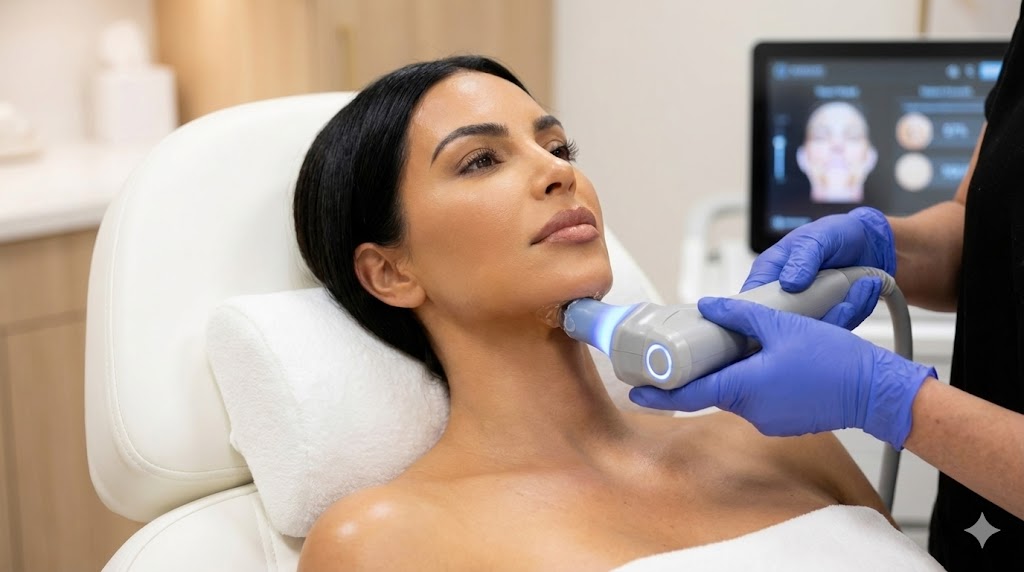
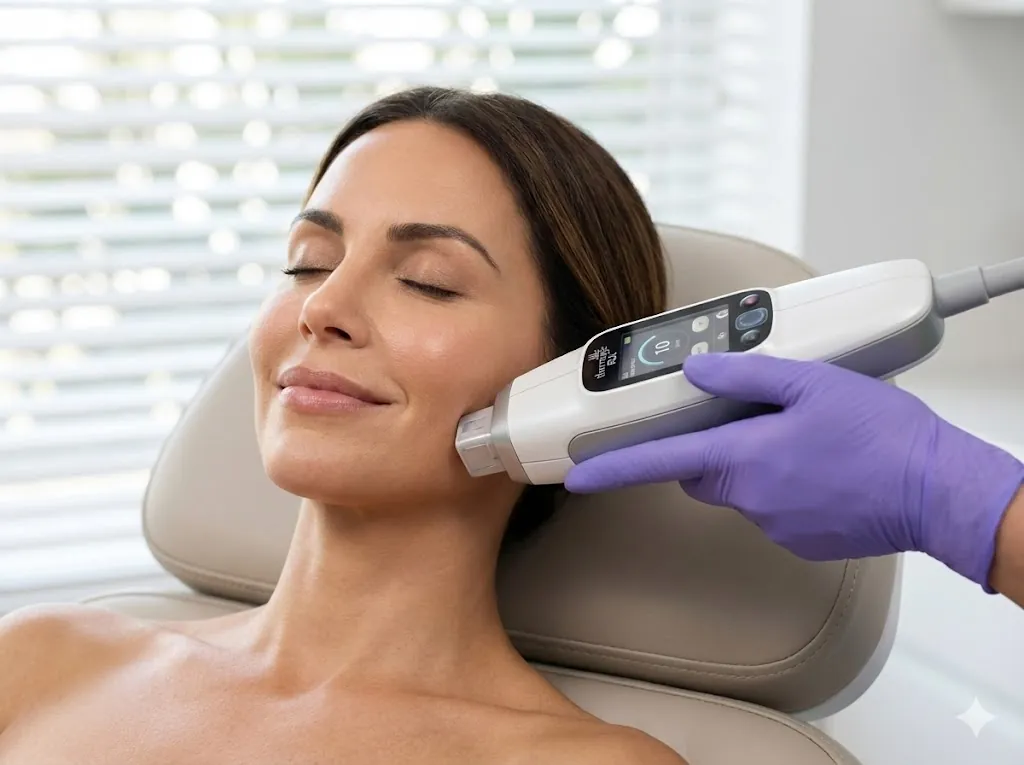
Thermage FLX is a non-surgical skin-tightening treatment that uses monopolar radiofrequency to heat the deep dermis while cooling the skin surface. The heat contracts existing collagen and triggers new collagen production over the following months, so results build gradually. A physician assessment decides whether it suits a person's degree of skin laxity.
If you're researching non-surgical skin tightening in Burnaby or the Greater Vancouver area, you've likely encountered Thermage FLX — a monopolar radiofrequency (RF) device and a widely used, clinically studied energy-based platform for facial and body laxity. At Skin Art MD, we consider Thermage FLX a cornerstone of our non-invasive lifting and tightening portfolio. Learn more about Thermage FLX and how we integrate it into individualized treatment plans.
Unlike laser technologies that target chromophores in the skin, Thermage FLX works through a fundamentally different mechanism: controlled volumetric heating of the deep dermis and subcutaneous fibrous septae.
This article offers a science-driven explanation of how Thermage FLX works at the cellular level, what the peer-reviewed literature says about its efficacy, and how our clinical team evaluates candidacy.
How Does Radiofrequency Remodel Collagen?
Thermage FLX heats the deep dermis through resistive (Joule) heating while cryogen cools the surface; the heat contracts collagen immediately and starts a wound-healing response that builds new collagen over 3–6 months.
The Physics of Monopolar RF Energy
Thermage FLX uses monopolar radiofrequency energy at approximately 6.78 MHz. When applied to tissue, RF energy does not generate heat through photon absorption — it generates heat through resistive heating (Joule heating). As the alternating electric current oscillates through tissue, the natural resistance of skin structures causes ionic kinetic energy to increase, producing thermal energy.
The engineering elegance of Thermage lies in how this heat is controlled. The treatment tip simultaneously delivers RF energy and cryogen spray cooling to the superficial epidermis — a bidirectional thermal profile that protects the outer skin surface while delivering targeted heat to the deep dermis (approximately 2–3 mm depth) and subcutaneous fibrous tissue. Peak temperatures in the target zone reach approximately 65–75°C, while the epidermis is maintained near baseline temperature.
Cellular Response: Collagen Denaturation and Neocollagenesis
At the molecular level, the key event is thermal denaturation of type I and type III collagen. Native triple-helix collagen contracts when heated to its denaturation threshold — the mechanism behind the immediate tightening effect some people notice before they leave the treatment room. More significantly, controlled thermal injury triggers a wound-healing cascade:
- Inflammatory phase: Heat shock proteins (HSPs) are upregulated. HSP47 and HSP70 — collagen chaperones — activate in response to thermal stress.
- Proliferative phase: Fibroblasts migrate to the injury site and begin synthesizing new procollagen.
- Remodeling phase: Over 3–6 months, new collagen fibers organize into a tighter, more structured extracellular matrix.
This biphasic response — immediate contraction followed by progressive neocollagenesis — explains why Thermage FLX results continue to improve for months after a single treatment session.
The FLX system also incorporates vibration technology built into the handpiece, which the manufacturer reports reduces discomfort without compromising energy delivery. The AccuREP™ algorithm continuously adjusts energy output based on real-time tissue impedance feedback, helping keep depth and temperature delivery consistent across different anatomical zones and tissue compositions.
What Does the Peer-Reviewed Literature Show?
Published studies have shown new collagen formation in skin biopsies and measurable improvement in facial and body laxity after monopolar RF, although individual results vary.
Histological Confirmation of Neocollagenesis
Zelickson et al., published in the Archives of Dermatology, conducted biopsy-confirmed histological analysis of skin treated with monopolar RF energy. Skin biopsies taken at 1 month and 3 months post-treatment demonstrated new collagen deposition in the deep reticular dermis — confirming that the mechanism is not simply collagen contraction but genuine de novo collagen synthesis. This histological data remains a foundational reference in the RF skin tightening literature.
Facial Skin Laxity Improvement
A controlled study by Suh et al., published in Dermatologic Surgery, evaluated monopolar RF in patients with mild-to-moderate facial laxity using blinded photographic assessment and standardized laxity grading scales. At six months post-treatment, a statistically significant proportion of participants demonstrated measurable improvement in jawline definition and mid-face tissue position, reinforcing that single-session monopolar RF can produce clinically meaningful outcomes in appropriately selected candidates.
Body Contouring and Tissue Tightening
Alster and Tanzi, in the Journal of Drugs in Dermatology, examined monopolar RF outcomes for non-facial applications including the abdomen and thighs. Their findings supported meaningful improvements in skin laxity at treated body sites with a favorable safety profile. No significant adverse events were recorded, and participant satisfaction scores were high among those whose expectations had been calibrated prior to treatment.
These studies collectively support what we observe clinically at Skin Art MD: Thermage FLX is a mechanistically sound, evidence-backed platform. That said, individual results vary based on baseline laxity, skin quality, age, and lifestyle factors.
How Does Thermage FLX Compare With HIFU (Ultherapy)?
Thermage FLX heats a broad volume of tissue from the dermis to the subcutaneous layer, while high-intensity focused ultrasound (HIFU) platforms such as Ultherapy focus energy at set depths, including the SMAS layer; the table compares the two.
| Feature | Thermage FLX (Monopolar RF) | Ultherapy (HIFU) |
|---|---|---|
| Energy type | Radiofrequency (resistive heating) | Focused ultrasound (mechanical + thermal) |
| Depth of action | Superficial dermis to subcutaneous | Deeper SMAS layer (4.5 mm), dermis (3 mm) |
| Treatment session | Single session (longer) | Single session |
| Discomfort level | Moderate (vibration assist reduces it) | Moderate to high |
| Typical focus | Skin texture + laxity, body areas | Deep structural lifting, brow, neck |
| Recovery | Usually brief; temporary redness possible | Usually brief; temporary redness or swelling possible |
| Collagen mechanism | Resistive heating → neocollagenesis | Focal thermal coagulation zones |
Key clinical distinction: Thermage FLX heats a broader volume of tissue continuously, making it well-suited to full-face tightening, skin texture refinement, and larger body areas. HIFU's focused acoustic energy creates discrete thermal coagulation points at precise depths — making it valuable when deeper SMAS-layer lifting is the primary goal.
At Skin Art MD, Dr. Sharon Fong, a physician, performs a thorough structural assessment to determine which modality — or combination — is most appropriate for each patient's anatomy and goals. There is no one-size-fits-all answer. Book a Consultation to discuss which approach suits your skin.
Who Tends to Respond Well to Thermage FLX?
Response tends to be more predictable with mild-to-moderate laxity, good baseline skin quality and realistic expectations, while severe excess skin or advanced sagging is less likely to respond; a physician assessment decides suitability.
Typical Candidate Profile
Thermage FLX delivers the most predictable results in people who present with:
- Mild to moderate skin laxity — early jowling, mild nasolabial fold deepening, early neck laxity
- Good baseline skin quality — the device works with the skin's existing fibroblast activity; severely photodamaged or very thin skin may respond less robustly
- Realistic expectations — Thermage FLX is a non-invasive maintenance and enhancement tool, not a surgical alternative
- Age range roughly 35–65 — typically enough collagen infrastructure to respond well, with enough laxity to benefit meaningfully
- Body applications: abdomen post-partum, inner thighs, arms, periorbital area, around knees — areas where surgical options feel disproportionate
The usual aim is to look like a refreshed version of oneself rather than dramatically different.
Less Suitable Presentations
Certain presentations are less likely to achieve satisfying outcomes:
- Severe skin redundancy (significant excess skin after major weight loss)
- Advanced facial ptosis where structural repositioning is the clinical need
- Expectations calibrated to surgical results
A consultation is always necessary to establish appropriateness. Our team at Skin Art MD in Burnaby provides a thorough assessment before any treatment commitment.
What Are the Limitations and Contraindications of Thermage FLX?
Results are gradual and fade over time, and the treatment is avoided or needs extra caution with implanted electronic devices, metal implants in the area, pregnancy, active skin problems and known collagen disorders.
Clinical Limitations
Thermage FLX is powerful but not unlimited in scope:
- Results are gradual — the full collagen remodeling effect emerges at 3–6 months, requiring patient patience
- The single-session protocol means the treatment investment is front-loaded; the timing of maintenance sessions is discussed at follow-up
- Results fade over time — the aging process continues, and biological collagen turnover means results will eventually require renewal
Medical Contraindications
Thermage FLX is contraindicated or requires additional caution in patients with:
- Active implanted electronic devices (pacemakers, defibrillators, cochlear implants) — RF current can interfere with device function
- Metal implants in the treatment zone — metallic hardware can cause unpredictable heating patterns
- Pregnancy — energy-based devices are not studied in pregnant populations
- Active skin infections, open wounds, or inflammatory skin conditions in the treatment area
- Known collagen disorders
Thermage FLX is used for the indications it is marketed for. At Skin Art MD, we follow the manufacturer's labelled indications and protocols.
Why Choose Skin Art MD for Thermage FLX in Burnaby?
Choosing where to receive an energy-based treatment matters more than many patients realize. The outcome of Thermage FLX depends not just on the device, but on who operates it and how the treatment is customized.
- Physician-led care: Every Thermage FLX treatment at Skin Art MD is performed or directly supervised by Dr. Sharon Fong, a physician. Medical oversight matters — tissue response assessment, treatment parameter customization, and contraindication screening require a trained clinical eye.
- Current-generation technology: We use the Thermage FLX platform — the current-generation system with AccuREP™ real-time impedance feedback and integrated vibration comfort technology.
- Personalized treatment plans: We start from an assessment rather than a set menu. Your anatomical structure, skin quality, and goals determine the treatment parameters. Pass counts, tip selection, and energy settings are individualized.
- Bilingual team: Our team serves both English- and Mandarin-speaking patients throughout Burnaby and the Greater Vancouver area, so treatment details, expectations, and aftercare can be discussed in Mandarin (普通话).
Book a Consultation to meet our team and explore whether Thermage FLX suits your skin.
Frequently Asked Questions
How long does a Thermage FLX treatment take?
A full-face treatment typically takes 60–90 minutes. Body treatments vary based on area — abdomen sessions are longer than targeted neck treatments.
Does Thermage FLX hurt?
Most people describe a warm, sometimes intense sensation during energy pulses followed by cooling. The FLX system's built-in vibration technology is designed to reduce discomfort compared with older-generation devices, and most people tolerate treatment without anaesthesia.
When will I see results?
Some people notice an immediate subtle tightening. The full benefit emerges gradually over 3–6 months as new collagen matures and reorganizes.
How long do results last?
How long results last depends on age, skin quality, and lifestyle, because collagen turnover continues; maintenance sessions are commonly planned with the physician.
How many sessions do I need?
Thermage FLX is designed as a single-session treatment. The protocol is calibrated to deliver sufficient energy in one session, with maintenance as needed.
Can Thermage FLX be combined with other treatments?
It can be. At Skin Art MD, Thermage FLX is sometimes combined with neuromodulators or dermal fillers as part of a broader aesthetic plan. Timing and sequencing matter — our physician advises on any combination after an assessment.
What affects the cost of Thermage FLX?
Cost varies with the area treated and the tip size selected. Because every plan is individualized, cost is explained at consultation once the plan has been made.
Next Steps
If you've read this far, you're doing exactly what a thoughtful patient should — researching before committing. Thermage FLX is a well-evidenced, non-invasive option for mild-to-moderate skin laxity and natural-looking, gradual improvement; most people resume normal activities the same day, though temporary redness or swelling is possible.
The next step is a personalized skin assessment with our team at Skin Art MD in Burnaby. We'll evaluate your skin structure, discuss your goals, and recommend a treatment plan — which may or may not include Thermage FLX, depending on what genuinely suits you. Book a consultation — available in English and Chinese.
This article is for educational purposes only and does not constitute medical advice. Please consult with a qualified healthcare professional before undergoing any treatment.