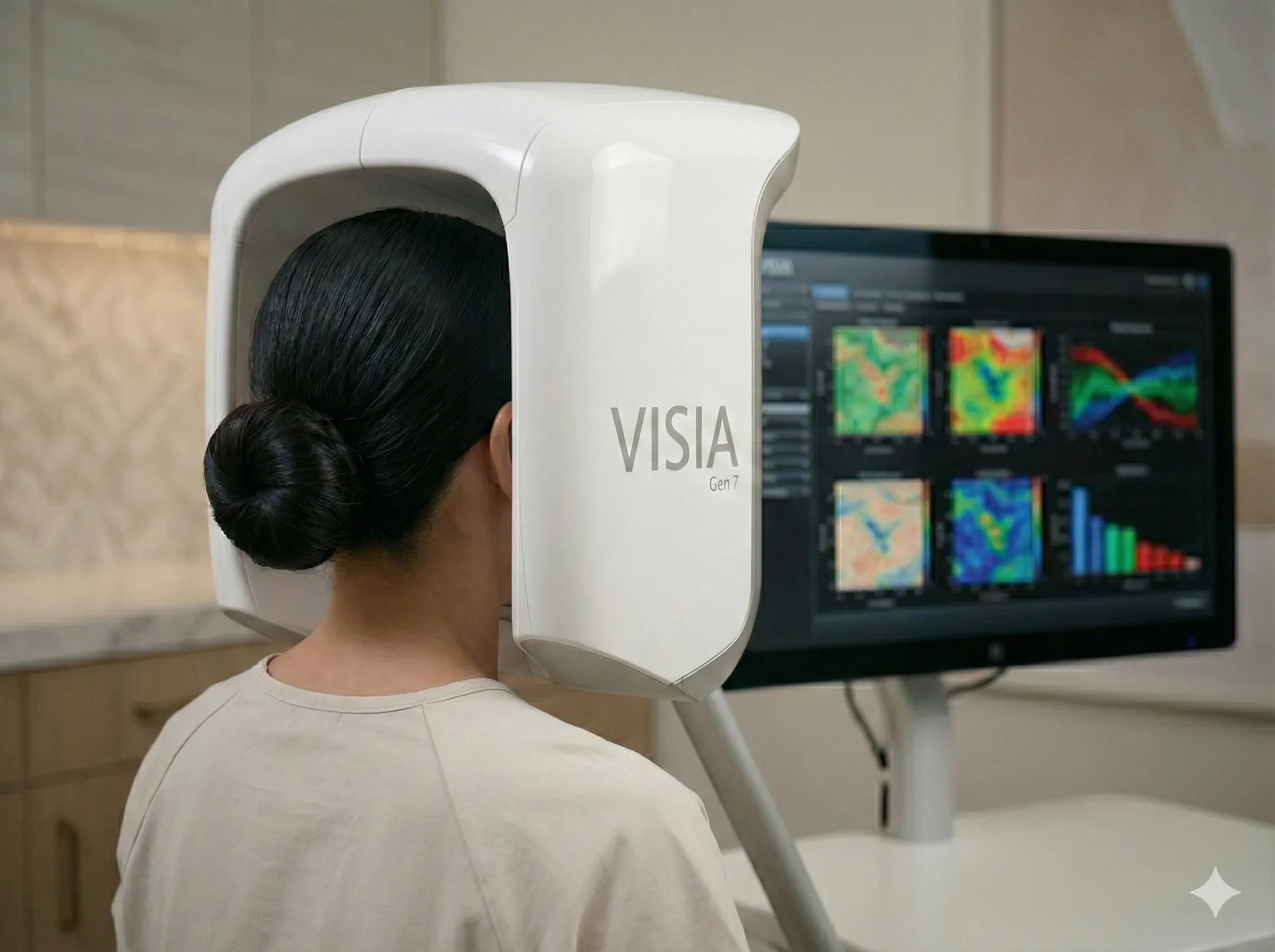
A VISIA skin analysis photographs your face under standard, cross-polarized and UV light and scores eight parameters — spots, wrinkles, texture, pores, UV spots, brown spots, red areas and porphyrins — against people of similar age and skin type. The capture takes about five minutes and the results help guide and track a treatment plan.
You wash your face twice a day, wear SPF, and invest in good serums. But do you know what's happening beneath the surface of your skin?
At Skin Art MD at Metrotown, a new skin assessment can begin with a VISIA Complexion Analysis — an AI-assisted imaging system that shows what the eye and a bathroom mirror cannot, so recommendations rest on measurements as well as visual assessment.
What Is VISIA Skin Analysis?
VISIA is a medical-grade facial imaging and analysis platform developed by Canfield Scientific, used by clinicians, plastic surgeons and research institutions internationally. Unlike a standard photograph or a magnifying lamp, VISIA uses multi-spectral imaging — including standard, UV, and cross-polarized lighting — to capture and quantify what's happening in different layers of your skin.
It shows not just the surface but the subsurface picture that influences how your skin ages and responds to treatment.
The 8 Dimensions VISIA Measures
Each VISIA scan generates scores across eight clinical parameters:
1. Spots Visible pigmented lesions on the skin's surface — including sun spots, age spots, and post-inflammatory hyperpigmentation — including those barely visible to the naked eye, giving a map of pigmentation.
2. Wrinkles VISIA maps fine lines and wrinkles across your face, scoring depth, length, and density, and can detect early lines before they deepen.
3. Texture Surface texture irregularities including roughness, unevenness, and micro-scarring. Skin that looks smooth may still have textural inconsistencies that affect light reflection.
4. Pores A pore analysis showing size, density, and distribution across facial zones. Enlarged pores can reflect oil production, congestion, or loss of elasticity.
5. UV Spots UV imaging reveals sun damage that hasn't yet surfaced — pigmentation changes in deeper layers that may later appear as visible dark spots.
6. Brown Spots Brown spot analysis focuses on melanin distribution and concentration, helping distinguish melasma, solar lentigines, and post-inflammatory changes, which call for different approaches.
7. Red Areas VISIA maps vascular activity and inflammation patterns, including rosacea, broken capillaries, and chronic irritation, which can be present in areas that look "normal".
8. Porphyrins Porphyrins are bacterial byproducts that indicate the presence of acne-associated bacteria in pores, a dimension a visual assessment cannot see. For acne-prone skin, porphyrin mapping shows areas of higher bacterial activity.
What Happens During a VISIA Session?
You arrive with a clean face and no makeup, VISIA takes a set of photographs under different lighting in about five minutes, its software scores the eight dimensions, and a practitioner walks you through the results and what they mean for your plan.
Step 1: The Capture (5 Minutes)
Our aesthetic practitioner positions you in the VISIA imaging booth, where a chin rest keeps positioning consistent. The system captures photographs under standard white light, cross-polarized light (which removes surface glare to show deeper structures), and UV light (which shows sun damage and bacterial activity).
The capture takes approximately five minutes and is non-invasive — no touching and no products.
Step 2: Analysis and Scoring
VISIA's algorithms analyze your images across all eight dimensions and generate a score for each. According to the manufacturer, scores are compared against a large reference database of faces matched to age, ethnicity, and skin type.
This puts your results in context. A pore score in the 65th percentile, for example, means your pores rank better than 65% of people your age with similar skin.
Step 3: Reviewing Your Results
Your Skin Art MD aesthetic practitioner walks you through each dimension, explaining what each score means and how it may shape your treatment plan.
For example, if UV imaging shows significant subsurface sun damage, a plan focused only on surface treatments may not be enough, and a PicoWay laser protocol followed by topical brightening may be discussed.
If porphyrin mapping shows bacterial activity in your T-zone, targeted extractions during HydraFacial sessions or adjustments to your skincare may be discussed.
Why Does Objective Skin Data Matter?
Objective imaging adds measurements to a visual assessment, so planning can address problems before they become visible and progress can be tracked consistently over time.
The Limits of Visual Assessment
Traditional skin consultations rely on visual assessment, often under lighting that flattens detail. Subsurface UV damage, early melasma and bacterial activity can be easy to miss without imaging.
Without objective data, treatment plans tend to be reactive rather than proactive.
What VISIA Adds
With VISIA, a treatment plan can be:
- Evidence-based: Recommendations are supported by measurements, not only impressions
- Proactive: Sun damage, bacterial buildup, and early wrinkle formation can be addressed before they become visible problems
- Trackable: Consistent, repeatable measurements make it possible to track change over time, rather than relying on photos that vary with lighting and angle
- Personalized: Your skin is compared against your demographic
- Focused: Identifying what needs attention helps avoid treatments you don't need
Findings VISIA Can Reveal
- UV damage in regular sunscreen users: Accumulated exposure from before sun protection began, or from inconsistent reapplication
- Chronic redness: "Occasional redness" can turn out to be ongoing vascular inflammation
- Asymmetric aging: One side of the face can age differently — often the side facing a car or office window — so treatment intensity can be adjusted by zone
- Porphyrins in "clear" skin: Elevated porphyrin levels can appear even without active breakouts, which allows preventive care
How Are VISIA Results Used in a Treatment Plan?
VISIA findings point to which concerns to prioritize — pigment, bacteria, texture, lines, redness or pores — and the treatment options for each are then decided at an assessment and re-checked with follow-up scans.
| VISIA Finding | Treatments Commonly Discussed |
|---|---|
| High UV spots / brown spots | PicoWay laser + brightening skincare |
| Elevated porphyrins | HydraFacial with targeted extraction + antibacterial skincare |
| Poor texture score | Microneedling |
| Wrinkle formation | Neuromodulator preventive approach |
| Red areas / inflammation | LED therapy + barrier repair regimen |
| Enlarged pores | Skin boosters + retinoid regimen |
Your plan can evolve with you. A follow-up VISIA scan every three to six months is commonly used to track progress and adjust the plan.
What Does VISIA Show That a Mirror Can't?
A mirror shows the surface under flattering light, while VISIA shows UV damage building beneath the surface, texture inconsistencies, bacterial activity and early wrinkle patterns.
At Skin Art MD at Metrotown, measuring before treating helps match the plan to what is actually happening in your skin.
What Do People Ask About VISIA?
Common questions cover preparation, comfort, how long it takes, tracking improvement and different skin tones.
Q: How should I prepare for my scan? A: Arrive with a clean face and no makeup. Avoid heavy moisturizers or sunscreen immediately before the scan, as they can create surface glare. Gentle cleansing wipes are available if needed.
Q: Does it hurt? A: No. VISIA is photographic — there's no contact with your skin and no products applied.
Q: How long does the full analysis take? A: The imaging capture takes about five minutes. Reviewing your results and discussing treatment options typically takes thirty to forty-five minutes.
Q: Can I see my improvement over time? A: Yes. VISIA stores your scan history, so previous images and scores can be compared to show measurable change.
Q: I have dark skin — does VISIA work for all skin tones? A: VISIA's reference database includes diverse skin types and ethnicities, and its multi-spectral imaging is used across Fitzpatrick skin types.
How Do I Book a VISIA Skin Analysis in Burnaby?
You can book a consultation at Skin Art MD at Metrotown, where a VISIA analysis can be part of your skin assessment; ask our team about current pricing.
Skin Art MD at Metrotown — Modern aesthetic medicine in Burnaby, BC. Serving Burnaby, Vancouver, New Westminster, Coquitlam, and Metro Vancouver.