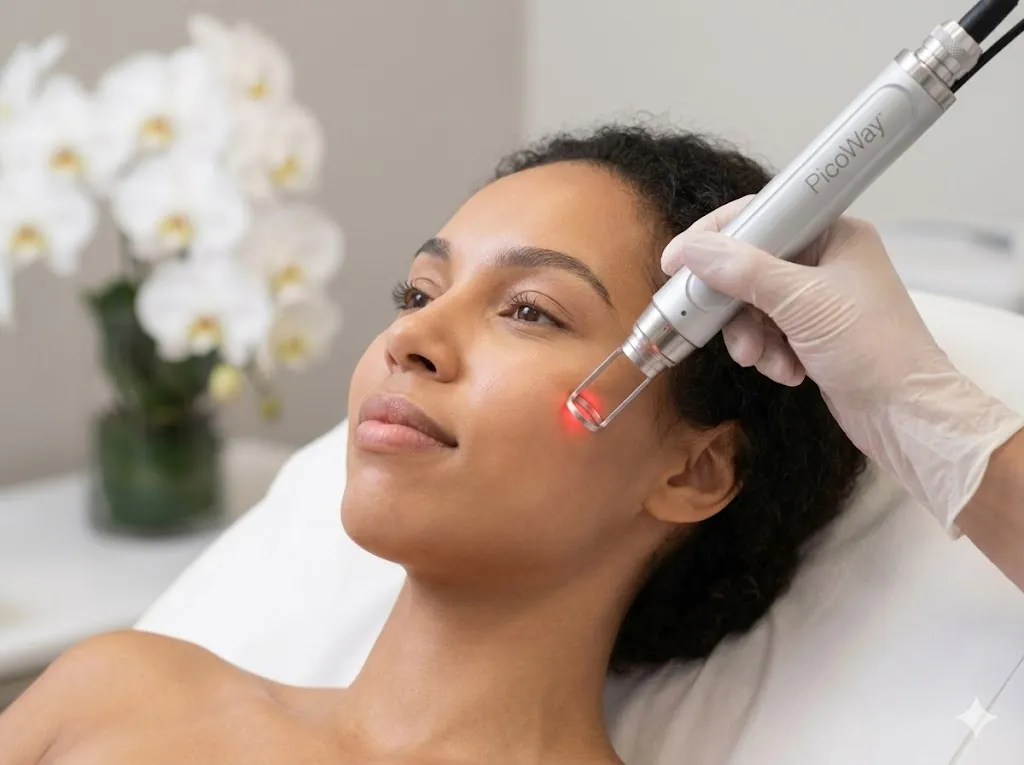
How many sessions laser tattoo removal takes, and what it costs, depends on the tattoo itself: its size, ink colours, how densely it was inked, how old it is, where it sits on the body, your skin type and how your body clears ink. Most tattoos need several sessions spaced roughly 6 to 8 weeks apart, and some ink may remain. At Skin Art MD in Burnaby, a quote is given after an in-person assessment.
That answer is honest but not very satisfying if you are trying to budget, so this article walks through each factor, how sessions are spaced, what "faded" versus "cleared" means, aftercare, and when it makes sense to wait. If you want detail on how the PicoWay laser handles different ink colours, our earlier article on PicoWay tattoo removal, ink colours and aftercare covers that. This one is about planning.
Why can't a clinic quote tattoo removal cost over the phone?
Because the two things that drive cost, the size of the treatment area and the number of sessions, can only be estimated by looking at the tattoo and your skin. Two tattoos of the same size can need very different plans.
Most clinics, including ours, price laser tattoo removal per session, with the session price depending on the area treated. The total you pay is therefore roughly the per-session price multiplied by the number of sessions you end up needing. The per-session part is easy to measure; the number of sessions is the uncertain part, and it is what the assessment is really about. A photo can help with a rough idea of size, but it cannot show ink depth, how the skin has healed, or your skin type under clinic lighting.
What factors affect how many sessions you need?
Several factors interact, and no single one decides the outcome. These are the ones the assessment looks at.
Size of the tattoo
Larger tattoos take longer per session and usually fall into a larger price band. Size does not always add sessions, but very large pieces are sometimes treated in sections, which changes how the plan is scheduled.
Ink colours
Black and dark blue-black ink absorb a wide range of laser wavelengths and tend to respond more predictably. Colours such as green, light blue, yellow, orange and some reds respond differently, and some pigments respond only partly. Multicoloured tattoos often take more sessions than black-only ones. Some white or skin-toned inks used in cosmetic tattoos can darken when hit by a laser, which is one reason a test spot is sometimes recommended.
Ink density: professional vs amateur
Professional tattoos usually have more ink, placed evenly and deeper, which often means more sessions. Amateur or "stick and poke" tattoos tend to have less ink at uneven depths and sometimes clear in fewer sessions, though this is a tendency, not a rule. Layered tattoos, such as a cover-up over an older piece, contain more ink and usually take longer.
Age of the tattoo
Older tattoos have already faded somewhat as the body slowly clears ink over the years, so they may respond in fewer sessions than a fresh piece. A tattoo should be fully healed before laser treatment; the team will advise on timing for a recent tattoo.
Location on the body
Areas with better blood and lymphatic circulation, such as the upper arm, chest and neck, tend to clear faster. Hands, feet, ankles and lower legs are further from the centre of circulation and often take more sessions.
Skin type
Darker skin tones contain more natural pigment, so settings are chosen more conservatively to reduce the risk of lightening or darkening of the surrounding skin. That can mean more sessions at gentler settings. This is a normal part of planning, not a barrier to treatment.
How your body clears ink
The laser breaks ink into smaller particles; your immune system then clears them over the following weeks. That clearance varies between people. Smoking, overall health and individual biology all play a part, which is why two people with similar tattoos can progress at different speeds. Individual results vary.
How far apart are tattoo removal sessions?
Sessions are typically spaced about 6 to 8 weeks apart, and sometimes longer. The gap gives the skin time to heal and the body time to clear fragmented ink.
Coming back sooner does not speed things up. Ink clearance happens between sessions, and treating skin that has not fully recovered raises the risk of skin texture or pigment changes. For planning, that means a course of several sessions can stretch over many months, and in some cases more than a year. If you have a deadline, such as a new job, a wedding or a cover-up appointment, tell the team at the assessment so the plan is realistic from the start.
Will the tattoo be fully removed?
Not always. Many tattoos fade substantially, and some clear to the point of being hard to see, but complete clearance cannot be promised. Some ink, especially certain colours, may remain as a faint shadow.
It helps to decide at the beginning what your actual goal is:
- Fading for a cover-up: you only need the old tattoo light enough for a tattoo artist to work over. This usually takes fewer sessions than aiming for clearance.
- Clearance as far as possible: you want the tattoo gone. Plan for more sessions and accept that a trace may remain.
- Partial removal: removing one element, such as a name, while keeping the rest.
Your goal changes the number of sessions, and therefore the overall cost.
What does the healing look like after each session?
Expect redness, swelling and a whitish frosting on the treated area right after the session, which usually settles within hours. Over the next few days, blistering, pinpoint bleeding, scabbing and itching can occur.
Typical aftercare guidance includes:
- Keep the area clean and follow the dressing instructions you are given.
- Do not pop blisters or pick scabs; this raises the risk of scarring and pigment change.
- Avoid soaking the area (hot tubs, swimming, long baths) until it has healed.
- Avoid shaving over the area while it is healing.
- Contact the clinic if you notice signs of infection, such as increasing pain, warmth, spreading redness or pus.
Most people describe the treatment itself as a series of sharp snaps, and cooling is used for comfort. Healing usually takes one to two weeks per session, though it varies.
Why does sun exposure matter?
Tanned skin has more active pigment, which competes with the ink for laser energy and raises the risk of lightening or darkening the surrounding skin. Treatment is usually postponed if the area is recently tanned.
Plan to keep the area covered or protected with sunscreen for several weeks before and throughout your course. For many people in Greater Vancouver, starting in autumn or winter, when the area is easier to keep out of the sun, makes a long course more manageable. Self-tanning products on the area should also be stopped beforehand.
Who should wait before starting tattoo removal?
Laser treatment is usually postponed for people who are pregnant or breastfeeding, have a recent tan, or have an active infection, rash or open wound in the area. Certain medications and health conditions also call for a delay or a discussion with your physician.
Examples the medical team will ask about include:
- Medications that increase light sensitivity, and some acne medications taken by mouth.
- Blood thinners, which can increase bruising.
- A history of keloid or raised scarring.
- Conditions or medications that affect the immune system or healing.
- A history of cold sores, if the tattoo is near the lips.
- Gold-based medications, past or present.
Bring a list of your medications and supplements to the assessment. If anything is uncertain, the team may ask you to check with your family physician first.
What happens at the assessment, and what is a patch test?
The assessment is a consultation where the team looks at the tattoo, asks about your health history and goals, and estimates a session range. You receive your quote after this, based on the area and the expected plan.
At Skin Art MD, tattoo removal is done with picosecond lasers, including PicoWay, in a physician-led clinic under the oversight of our medical team. The assessment covers ink colours, density, location and skin type, and the device and wavelength choices that follow from them. For some tattoos, particularly cosmetic tattoos, light or coloured inks, or darker skin types, a small test spot may be suggested to see how the ink and skin respond before committing to a full course.
You can read more about the treatment itself on our laser tattoo removal page.
How can you plan your budget and timeline?
Ask for an estimated session range rather than a single number, and plan your budget around the upper end. Because of the 6 to 8 week spacing, also plan the calendar: five or six sessions can easily span most of a year.
Questions worth asking at any clinic:
- What session range do you expect for this tattoo, and why?
- Is the price per session based on area, and does it change if the tattoo fades?
- Are packages offered, and what happens if fewer sessions are needed?
- Who performs the treatment, and who oversees it?
- What device and wavelengths will be used for my ink colours?
FAQ
How many sessions does laser tattoo removal take? It varies. Several sessions are typical, and multicoloured, professional or densely inked tattoos usually need more. The team estimates a range at your assessment.
Can I come back sooner than 6 weeks to finish faster? Usually not. Ink is cleared between sessions, and shorter gaps increase the risk of skin changes without speeding up clearance.
Does a smaller tattoo always cost less? Per session, usually yes. In total, not always, because a small but densely inked or colourful tattoo can need more sessions than a larger, faded one.
Can laser tattoo removal leave a scar? Scarring and changes in skin colour are possible risks, especially if blisters are picked or the skin is treated while tanned. Following aftercare reduces the risk.
Can I get a cover-up tattoo afterwards? Yes, many people fade a tattoo to prepare for a cover-up. Discuss timing with both the clinic and your tattoo artist.
Do you treat cosmetic tattoos such as eyebrows? Cosmetic tattoos can be assessed. Some cosmetic inks can darken with laser, so a test spot is often part of the plan.
Booking
The first step is an assessment at our Burnaby clinic near Metrotown, where the team reviews your tattoo, health history and goals and gives you a quote based on your plan. You can book a tattoo removal assessment online.