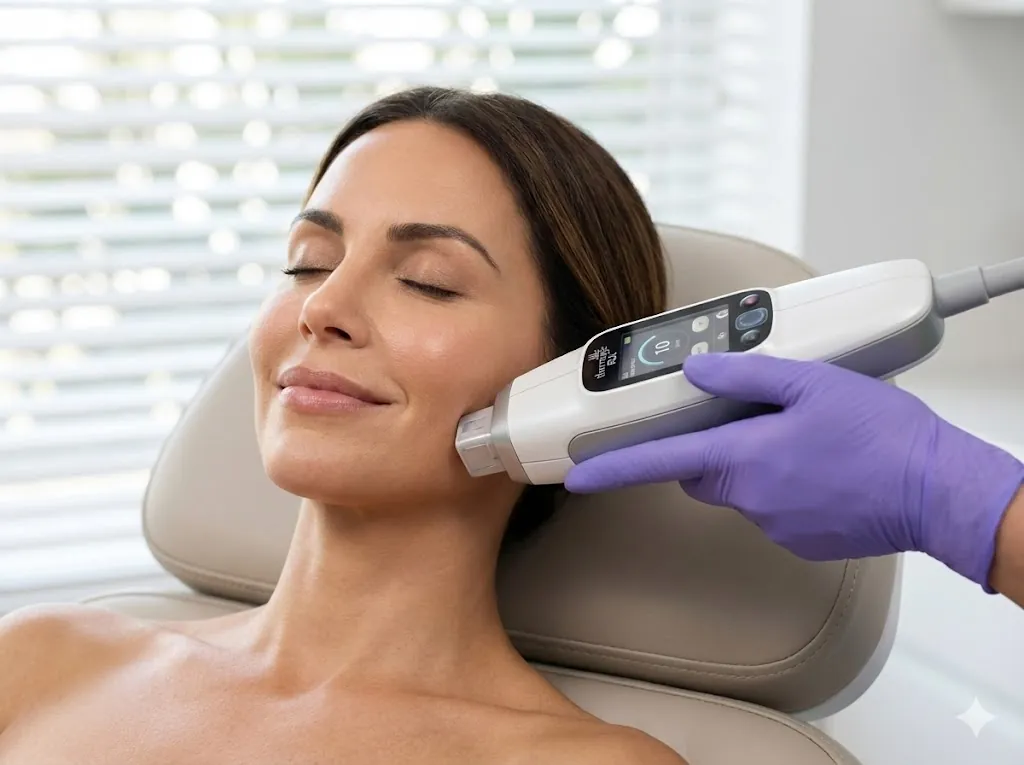
Thermage FLX is a non-invasive monopolar radiofrequency treatment that heats the deeper dermis to contract existing collagen and stimulate new collagen over roughly 3–6 months. Some people in their 30s use it as a preventative, maintenance-style treatment for early laxity; whether it suits a given person is decided at a physician assessment.
If you follow K-beauty trends or keep up with aesthetic medicine in Seoul, you have probably noticed something: Thermage is not just for your mom anymore. In Korea, Thermage FLX has become a rite of passage for women (and men) entering their 30s — a once-a-year investment in skin quality aimed at keeping skin firm and naturally youthful.
At Skin Art MD in Burnaby, we are bringing that same philosophy to Metro Vancouver. Here is everything you need to know about Thermage FLX as a preventative anti-aging treatment.
What Is Thermage FLX?
Thermage FLX is the fifth generation of Solta Medical's radiofrequency (RF) skin tightening system. It delivers monopolar RF energy deep into the dermis, heating collagen fibers to temperatures cited in Solta Medical's materials as 65-75 degrees Celsius. This controlled thermal injury triggers three biological responses:
- Immediate collagen contraction — existing collagen fibers shorten and tighten on the spot
- Neocollagenesis — your body produces fresh, organized collagen over the next 3-6 months
- Elastin remodeling — the elastic scaffolding of your skin is rebuilt from within
The "FLX" generation introduced AccuREP technology, which automatically optimizes RF energy delivery for every pulse — meaning more consistent results with greater comfort compared to older Thermage systems.
Why Do Some People Start Thermage FLX in Their 30s?
Some people start in their 30s because collagen production gradually declines with age, and a preventative approach aims to support existing collagen before laxity becomes pronounced.
Collagen production gradually declines from around the mid-20s. By the early 30s, the cumulative change can become visible — subtle jawline softening, early nasolabial folds, skin that does not bounce back quite the way it used to.
The Korean "Maintenance Mindset"
In Korean aesthetic culture, the goal is never to look "done." It is about maintaining your baseline, so that more aggressive interventions may be postponed. Thermage FLX fits this philosophy well:
- Single session, little interruption — most people return to normal activities the same day
- Results build gradually — changes look natural rather than sudden
- Periodic maintenance — repeat sessions are often planned to help sustain collagen
- No needles, no incisions — purely external energy delivery
Why Is the 30s Often Discussed?
Skin in the 30s still has significant collagen reserves to work with. Thermage FLX is not creating something from nothing — it stimulates and helps preserve what is already there. The reasoning commonly given for starting earlier:
- There is more existing collagen for the treatment to stimulate
- Maintenance can begin before laxity becomes pronounced
Whether treatment is appropriate at any age is decided at a physician assessment.
What Happens During a Thermage FLX Treatment?
A treatment starts with a skin assessment and standardized photos, followed by a 45–90-minute session with built-in cooling and vibration; mild redness usually settles within a couple of hours.
Pre-Treatment Consultation
Every Thermage journey at Skin Art MD begins with a thorough skin assessment. The Skin Art MD team evaluates your skin laxity, collagen quality, facial volume, and aesthetic goals. We use standardized photography to track your progress over time.
We believe in honest conversations — if your skin does not need Thermage yet, we will tell you. If a different treatment serves you better, we will recommend that instead.
Treatment Day
- Duration: 45-90 minutes depending on treatment area (full face typically 60 minutes)
- Comfort: The FLX system's vibration and cooling mechanisms make it significantly more tolerable than previous generations. The sensation is commonly described as "warm with occasional hot spots"
- Areas treated: Full face, jawline, neck, and periorbital (around the eyes) — the 900-tip count covers comprehensive facial treatment
- Immediate after: Mild redness lasting 1-2 hours; most people return to normal activities the same day
Results Timeline
| Timeframe | What You Will Notice |
|---|---|
| Day 1-7 | Subtle tightness, mild glow |
| Week 2-4 | Skin texture improvement, pores appear refined |
| Month 1-3 | Progressive lifting and tightening becomes visible |
| Month 3-6 | Peak results — jawline definition, smoother nasolabial area, firmer skin overall |
| Month 6-12 | Results gradually fade over time; maintenance sessions are sometimes planned |
How Does Thermage FLX Compare With Other Tightening Treatments?
Thermage FLX heats the dermis with radiofrequency, whereas Ultherapy targets the deeper SMAS layer with ultrasound, thread lifts give a temporary mechanical lift, and RF microneedling focuses more on surface concerns.
Thermage FLX vs Ultherapy
- Thermage uses radiofrequency (heats the dermis); Ultherapy uses micro-focused ultrasound (targets SMAS layer)
- Thermage is generally more comfortable and better for overall skin quality
- Ultherapy may provide deeper lifting but with more discomfort
- Some Korean clinics combine both as a "tighten + lift" protocol
Thermage FLX vs Thread Lifts
- Thermage is completely non-invasive — no punctures, no foreign materials
- Thread lifts provide immediate but temporary mechanical lifting
- Thermage builds your own collagen, so changes develop gradually and look natural
- Which option fits a given person is decided at a physician assessment
Thermage FLX vs RF Microneedling (Sylfirm X, Morpheus8)
- Thermage penetrates deeper (up to 4.3mm vs 1-3mm for most RF microneedling)
- RF microneedling is more often used for surface-level concerns (acne scars, texture, pigmentation)
- Thermage is used for volumetric tightening and lifting
- The two treatments complement each other beautifully — Thermage for deep tightening, RF microneedling for surface refinement
Who Is Thermage FLX Commonly Considered For?
Thermage FLX is commonly considered for mild to moderate skin laxity, often between the late 20s and mid 40s; significant volume loss or severe laxity usually calls for other options, and a physician assessment decides suitability.
Situations Where It Is Commonly Considered
- Age 28-45 with mild to moderate skin laxity
- Early jawline softening or loss of facial definition
- A wish to maintain skin quality without injections
- A preference for a single-session treatment with little interruption to daily life
- Interest in a proactive "Korean beauty maintenance" approach
When Other Options May Be Discussed
- Significant volume loss (fillers or Sculptra may be more appropriate first)
- Severe skin laxity (surgical options may need to be discussed)
- Active skin infections or inflammatory conditions in the treatment area
- Pregnancy or breastfeeding
How Is Thermage FLX Cost Determined?
Cost depends on the treatment area and tip count, and is discussed at a consultation once the treatment plan is set.
Treatment options at Skin Art MD in Burnaby include:
- Full face (900 tips)
- Full face + neck
- Eyes only (225 tips)
- Body areas, planned by treatment zone
The consultation determines the appropriate tip count and treatment plan for your goals.
What Aftercare Helps After Thermage FLX?
Aftercare is simple: daily sunscreen, resuming retinoids after about 3 days, staying hydrated and avoiding extreme heat for 48 hours all support the collagen-remodeling process.
The beauty of Thermage FLX is minimal aftercare, but you can optimize results:
- SPF 50 daily — non-negotiable. UV exposure degrades new collagen.
- Retinol or retinoid — resume 3 days post-treatment to support collagen synthesis
- Hydration — hyaluronic acid serums support the skin barrier during remodeling
- Healthy lifestyle — adequate sleep, hydration, and nutrition support your body's collagen-building process
- Avoid extreme heat — skip saunas and hot yoga for 48 hours post-treatment
How Does Thermage FLX Fit Into a Skin Routine?
Thermage FLX is often placed within a broader yearly plan alongside facials, light peels and RF microneedling, each addressing a different concern; the plan is set after a physician assessment.
At Skin Art MD, we often build Thermage FLX into a comprehensive annual skin maintenance plan:
- Monthly: HydraFacial for ongoing clarity and glow
- Quarterly: LED therapy or light chemical peels for texture maintenance
- Annually: Thermage FLX for deep collagen renewal and tightening
- As needed: Sylfirm X for specific concerns like pigmentation or acne scarring
This layered approach mirrors the Korean "skin investment" philosophy — consistent, strategic treatments that compound over time.
What Do People Ask About Thermage FLX?
Common questions cover comfort, how long results last, body treatment, how many sessions are needed, and how it compares with at-home devices.
Q: Does Thermage FLX hurt? A: The FLX generation is significantly more comfortable than older versions. The sensation is commonly described as warm with occasional hot spots, and the built-in vibration and cooling mechanisms help manage it. Topical anesthesia is usually not needed, though it can be applied for sensitive clients.
Q: How long do results last? A: It varies with age, skin condition and lifestyle. Results fade gradually over time, and maintenance sessions are sometimes planned to help sustain collagen levels.
Q: Can I do Thermage FLX on my body? A: Yes. Thermage FLX can also be used on body areas including the abdomen, arms, thighs, and buttocks. Body treatments use a specialized 16.0 cm² tip for larger areas.
Q: Is one session really enough? A: One session delivers the treatment; whether and when to repeat it is discussed at follow-up. People with more advanced laxity may benefit from combining Thermage with other modalities.
Q: How does Thermage FLX compare to at-home RF devices? A: At-home devices operate at a fraction of the energy level (typically 1-5 MHz at low power vs Thermage's 6.78 MHz monopolar at therapeutic power). They cannot reach the deep dermal temperatures needed for true collagen remodeling. Professional Thermage FLX is in a completely different category.
How Do You Start With Thermage FLX?
The first step is a consultation at Skin Art MD in Burnaby, where the team assesses skin laxity and goals before any treatment plan is made. Book a consultation to discuss a personalized prevention plan.
Skin Art MD — Metrotown, Burnaby BC. Serving Burnaby, Vancouver, New Westminster, Coquitlam, and Metro Vancouver.