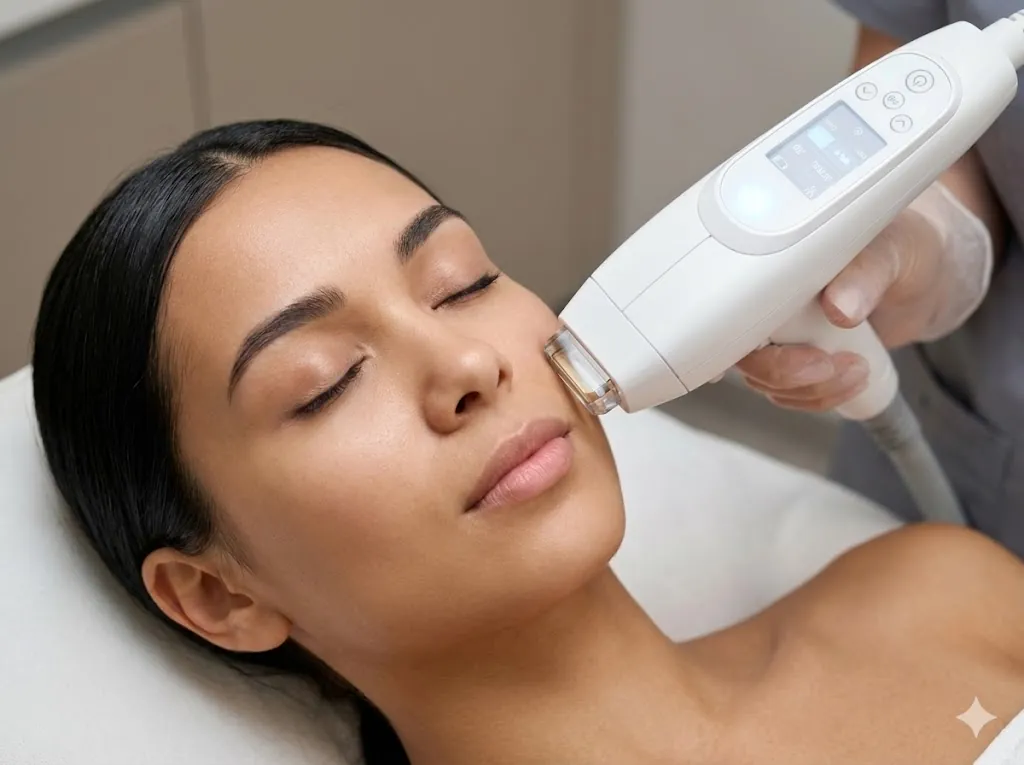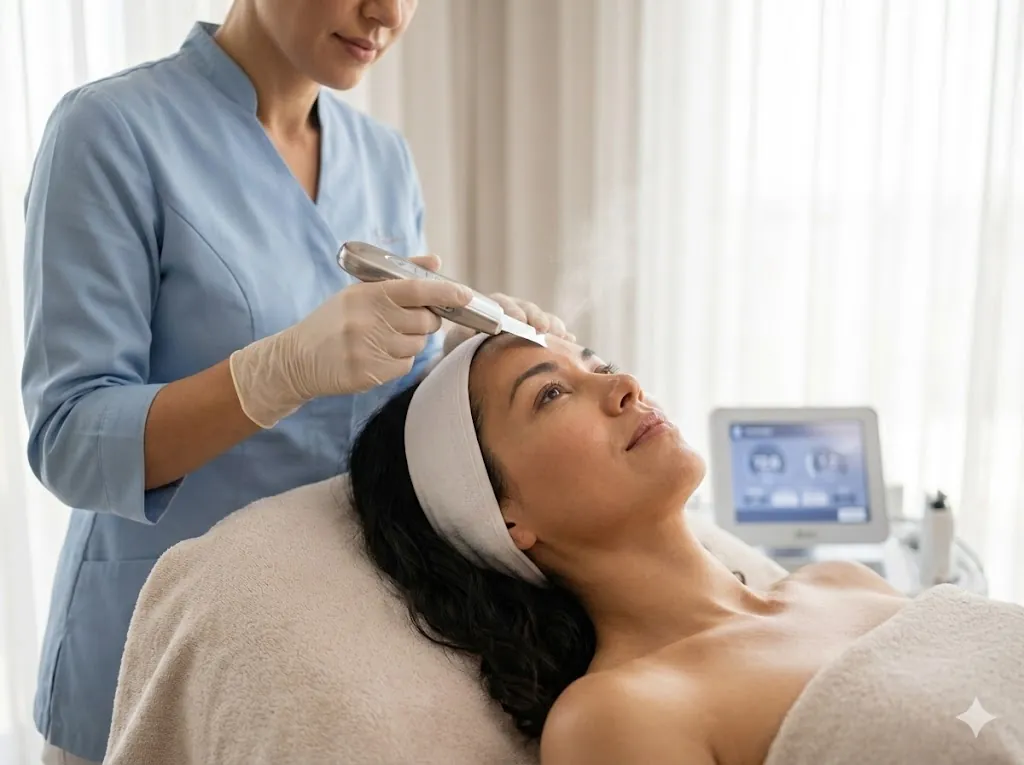
A V-Carbon peel is a non-laser carbon and acid peel: a film of activated vegetable carbon with mandelic, ferulic and citric acids is activated with a spray, left on for about 5 to 10 minutes, then neutralized and removed. The carbon helps lift oil and debris from the pores while the acids exfoliate the surface. It is used for congestion, dullness and early photoaging, and no laser is used at any step.
The evolution of skin resurfacing has moved beyond simple exfoliation toward targeted biochemical modulation. In the landscape of modern aesthetics, the V-Carbon system represents a sophisticated intersection of organic chemistry and clinical efficacy.
It is sometimes compared with the "Hollywood Peel", but it is a different product: treatments sold under that name pass a laser over carbon on the skin, while V-Carbon at Skin Art MD uses no laser and no laser heat.
At Skin Art MD in Burnaby, BC, our approach to skin health is rooted in physician-led precision.
Under the guidance of Dr. Sharon Fong, a licensed physician, we prioritize treatments that deliver cellular-level results while keeping safety central for our diverse patient population in the Greater Vancouver area. Learn more about V-Carbon Peel to understand its foundational role in our clinical offerings.
How does V-Carbon work?
V-Carbon uses no laser. It is a superficial to medium-depth peel system made in Italy by Promoitalia, with three parts: a carbon film, an activating spray and a neutralizing step. The spray lets the clinician adjust how deep the peel works.
1. The Role of Activated Carbon
The primary component is vegetable-activated carbon. In biochemical terms, activated carbon possesses an incredibly high surface-area-to-volume ratio, allowing it to act as a molecular sieve. It adsorbs—rather than absorbs—impurities, sebum, and environmental pollutants from the follicular infundibulum. This deep detoxification prepares the stratum corneum for the synergistic action of the system’s organic acids.
2. Synergistic Acid Complex
The V-Carbon film contains three acids:
- Ferulic Acid: A potent antioxidant that neutralizes free radicals and provides photo-protection. It works synergistically with other acids to stabilize the skin barrier.
- Mandelic Acid: An alpha-hydroxy acid (AHA) with a larger molecular size, allowing for slower, more controlled penetration. It is particularly effective for treating inflammatory acne due to its antibacterial properties.
- Citric Acid: Part of the acid complex that helps loosen dead cells and exfoliate the surface.
3. Activation and Neutralization
The spray is misted over the film to activate it; slight warmth or tingling is normal. For about 5 to 10 minutes the carbon draws out oil and debris while the acids exfoliate the surface, then the film is removed and the skin is neutralized and soothed. Peel depth and session spacing are chosen with pigment rebound in mind, starting gently on skin that marks easily. Book a Consultation to see if this biochemical approach is suitable for your specific skin concerns.
What does the research say about carbon and acid peels?
Much of what is published about "carbon peels" concerns the laser version, which is a different treatment, so those findings do not describe V-Carbon. V-Carbon's ingredients are familiar in skin care: activated carbon to help draw oil and debris from the pores, and mandelic, ferulic and citric acids to exfoliate the surface. Results vary from person to person.
At Skin Art MD, Dr. Sharon Fong uses this clinical evidence to customize treatment protocols. Every patient has a careful assessment to ensure the V-Carbon system aligns with their physiological needs and aesthetic goals.
How does V-Carbon compare with a carbon laser facial or a chemical peel?
V-Carbon works with a carbon film and mild acids and uses no laser, a carbon laser facial passes a laser over carbon on the skin, and a standard chemical peel relies on stronger keratolysis with more recovery time.
| Feature | V-Carbon System | Traditional Carbon Laser | Standard Chemical Peel |
|---|---|---|---|
| Mechanism | Carbon film + acid complex, activated by a spray; no laser | Laser passed over carbon on the skin | Chemical Keratolysis |
| Laser Heat | None | Yes | None |
| Downtime | Redness usually fades in 1 to 2 hours | Varies with settings | 3-7 days |
| Skin Type Considerations | Assessed for each Fitzpatrick type | Caution with Type V-VI | Varies by Acid Type |
| Primary Benefit | Cleansing & Immediate Glow | Collagen Remodeling | Deep Resurfacing |
Which skin concerns is V-Carbon used for?
V-Carbon is commonly used for congested or acne-prone skin, dullness, early photoaging and enlarged pores; whether it suits a particular skin is decided at a physician assessment during your consultation.
Concerns it is commonly used for:
- Congested or Acne-Prone Skin: The antibacterial properties of Mandelic acid combined with the cleansing action of carbon help address active comedones.
- Epidermal Dullness: People wanting a quick improvement in skin radiance before events.
- Early Signs of Photoaging: Fine lines and minor pigmentary irregularities can respond to the antioxidant profile of Ferulic acid.
- Enlarged Pores: The deep cleansing action helps reduce the appearance of the follicular openings.
Limitations & Contraindications: V-Carbon is generally well tolerated, but it may not be suitable for those with active cystic acne, open wounds, or hypersensitivity to any of the organic acids listed. Dr. Sharon Fong ensures that all contraindications are screened during the initial medical assessment.
What is V-Carbon like at Skin Art MD in Burnaby?
At Skin Art MD, V-Carbon is applied under physician direction, explained in English or Mandarin, and can be combined with other treatments in a personalized plan.
- Physician Oversight: Dr. Sharon Fong provides medical direction, so that treatments like V-Carbon are applied with precision.
- Bilingual Care: We understand the diverse cultural landscape of Burnaby and Metrotown. Our staff provides services in both English and Mandarin (普通话), ensuring clear communication regarding your treatment plan.
- Personalized Protocols: We do not believe in a one-size-fits-all approach. Your V-Carbon treatment may be combined with other modalities as part of your plan.
Frequently Asked Questions
Does the V-Carbon treatment hurt? Most people describe the sensation as a cool, refreshing application followed by a slight tingling during the activation phase. No laser is used, so there is no laser heat, and numbing is not needed.
How many sessions are usually needed? A single session gives an immediate improvement in skin brightness and texture; for cumulative benefits in acne management and anti-aging, a series of 4 to 6 treatments spaced 2 to 4 weeks apart is typical.
What is the downtime after a V-Carbon peel? Downtime is minimal. Redness usually fades within 1 to 2 hours, mild flaking, if any, settles in 2 to 3 days, and most people return to normal activities the same day. Avoid direct sun exposure and wear a broad-spectrum SPF.
Can I get this treatment if I have sensitive skin? The V-Carbon system is adjustable: the activating spray lets the clinician control how deep the peel works, though very sensitive or inflamed skin may need to settle first. A consultation with Dr. Fong determines the approach.
How much does V-Carbon cost? Prices are not published; the cost is discussed at consultation based on your plan.
How do I start V-Carbon in Burnaby?
If you are looking for a science-based way to refresh your skin and address congestion with less recovery time than traditional peels, the first step is an assessment. Book a consultation at Skin Art MD in Burnaby — available in English and Chinese.
Disclaimer: This article is for educational purposes only and does not constitute medical advice. Please consult with a qualified healthcare professional before undergoing any treatment.