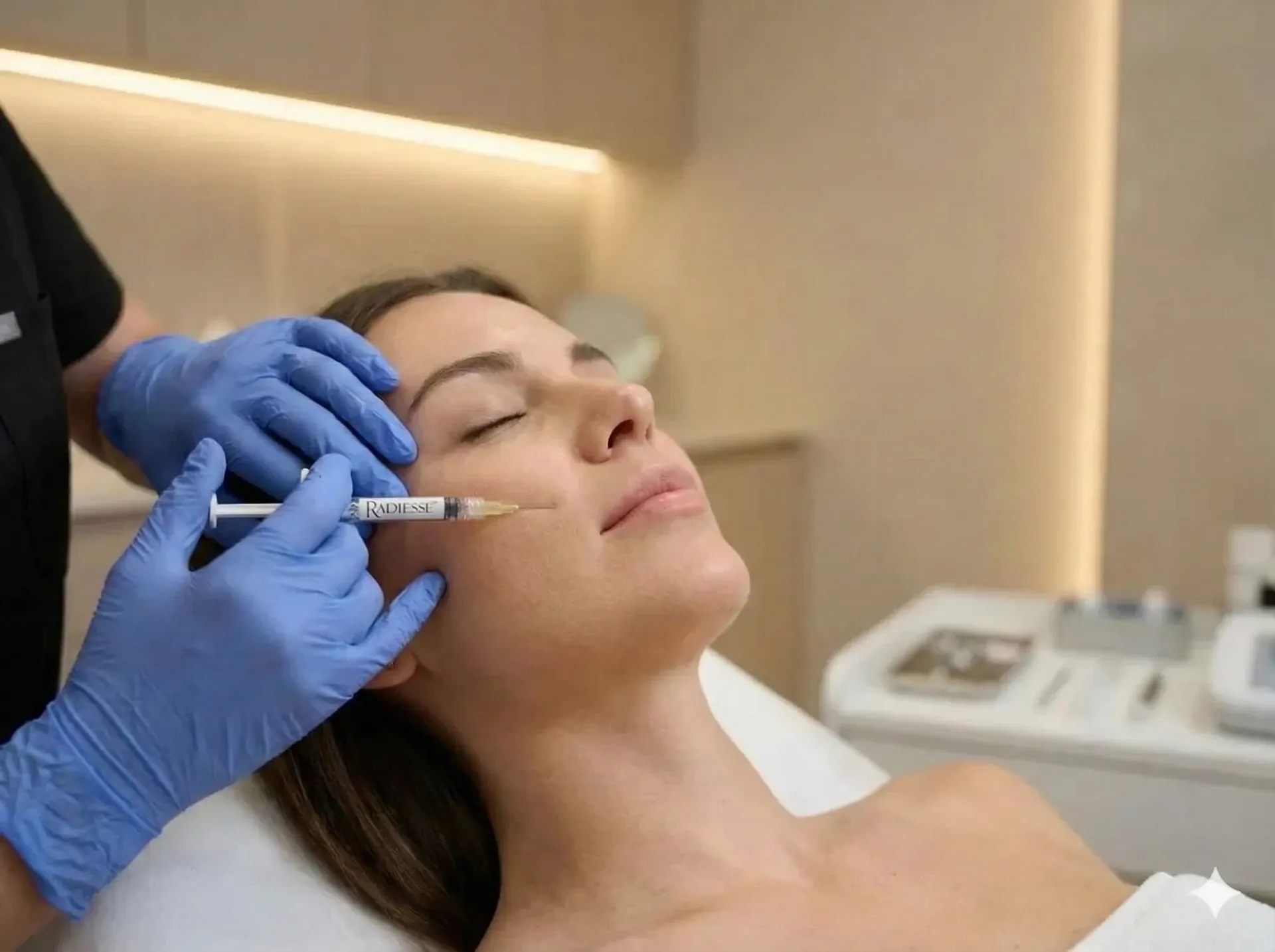
Radiesse is a calcium hydroxylapatite (CaHA) injectable that works in two ways: its gel gives immediate structural volume, and its microspheres prompt the skin to build new collagen over the following months. It is used for the jawline, cheeks, temples and the backs of the hands, and a physician assessment decides whether it suits you.
In the world of injectable aesthetics, most products do one thing: hyaluronic acid (HA) fillers add volume, and biostimulators like Sculptra build collagen over time. Radiesse does both — simultaneously. It's the Swiss Army knife of injectables, and at Skin Art MD at Metrotown it is used for people who want both immediate structure and gradual skin quality improvement.
Here's how it works, where it is used, and what a visit involves.
What Is Radiesse and How Does It Work?
Radiesse is a calcium hydroxylapatite (CaHA) injectable. Don't let the chemistry scare you — CaHA is a mineral that naturally occurs in your bones. Radiesse suspends CaHA microspheres in a smooth gel carrier, creating a product with a unique dual mechanism:
Mechanism 1: Immediate Volume (The Filler Effect)
The moment Radiesse is injected, the gel carrier provides instant volume and structural support. It's thicker and more viscous than most HA fillers, making it particularly effective for areas that need robust structural reinforcement rather than soft, cushioning volume.
Mechanism 2: Collagen Biostimulation (The Long Game)
Over the following weeks and months, the CaHA microspheres act as a scaffolding matrix. Your body's fibroblasts (collagen-producing cells) migrate to the microspheres and begin depositing new collagen around them. The gel carrier gradually absorbs, and the CaHA microspheres slowly dissolve — but the new collagen they stimulated remains.
The result? Longer-lasting volume than many HA fillers, with gradual skin quality improvement that continues even after the product itself has been absorbed.
Radiesse vs. Hyaluronic Acid Fillers
| Feature | Radiesse (CaHA) | HA Fillers (Juvederm, Restylane) |
|---|---|---|
| Immediate volume | Yes | Yes |
| Collagen stimulation | Yes — significant | Minimal |
| Longevity | Longer-lasting (collagen effect) | Varies by product |
| Reversible | No (not dissolvable) | Yes (hyaluronidase) |
| Typical use | Structure, jawline, hands | Lips, under-eyes, soft volume |
| Consistency | Thicker, more structural | Softer, more malleable |
Radiesse vs. Sculptra
Both are biostimulators, but they work differently:
| Feature | Radiesse | Sculptra |
|---|---|---|
| Active ingredient | Calcium hydroxylapatite | Poly-L-lactic acid (PLLA) |
| Immediate volume | Yes | No (volume builds over months) |
| Sessions needed | Often fewer | Usually a series |
| Onset of collagen | Begins within weeks | Begins within weeks |
| Typical use | Targeted structural areas | Widespread volume restoration |
Where on the Face and Body Is Radiesse Used?
Radiesse is mainly used where structure matters — the jawline, cheeks and temples — and on the backs of the hands, with a diluted form used for broader skin-quality treatment of areas such as the neck.
Face: Jawline Definition and Contouring
This is Radiesse's superpower. Its thicker consistency makes it well suited to creating sharp, defined jawlines and restoring the chin-to-neck angle. For early jowling or jawline softening, Radiesse provides both immediate structural improvement and ongoing collagen reinforcement.
Face: Cheek and Mid-Face Restoration
Volume loss in the cheeks is one of the earlier visible signs of aging — it creates hollows, deepens nasolabial folds, and makes the face look tired. Radiesse restores cheek projection and fullness while simultaneously stimulating collagen in this high-impact area.
Face: Temples and Pre-Auricular Area
Hollow temples are a telltale sign of aging (and often overlooked). Radiesse fills these depressions while building collagen to maintain the result longer than HA fillers alone.
Hands: The Age Giveaway
Your hands age faster than your face — they're constantly exposed to sun, chemicals, and friction. Volume loss makes veins, tendons, and joints more prominent, creating a skeletal appearance. Radiesse is physician-administered and is also used for hand rejuvenation.
The treatment involves injecting Radiesse across the back of the hands, then massaging it evenly. The result is immediate volume restoration that softens the appearance of veins and tendons, with collagen stimulation that improves skin quality over months.
Hyperdilute Radiesse: The Skin Quality Protocol
A newer approach in aesthetic medicine is hyperdilute Radiesse — mixing Radiesse with saline or lidocaine to create a thinner solution that can be distributed broadly across larger areas like:
- Neck and decolletage (crepey skin, fine lines)
- Inner arms (thinning, textural changes)
- Above the knees (skin laxity)
- Jawline and lower face (broad collagen stimulation)
Hyperdilute Radiesse isn't about adding volume — it's purely about collagen biostimulation over a wide surface area. Think of it as a collagen-building treatment for skin quality, texture, and tightness.
What Happens During a Radiesse Appointment at Skin Art MD?
A Radiesse appointment has three parts: a physician assessment that maps where (and whether) Radiesse fits, the injection itself with cannula or needle, and then immediate results followed by gradual collagen improvement.
Step 1: Comprehensive Facial Analysis
We begin with a thorough assessment of your facial structure, areas of volume loss, skin quality, and aesthetic goals. Radiesse isn't appropriate for every area (we don't use it in lips or under-eyes), so we'll map where it is suitable for your specific needs.
Step 2: Treatment
Treatment takes approximately 30-45 minutes depending on the areas treated. We use a combination of cannula and needle techniques:
- Cannula: For broader areas like cheeks and hands — less bruising, smoother distribution
- Needle: For precise jawline definition and targeted structural support
Radiesse contains integrated lidocaine, so the treatment itself is quite comfortable after the initial entry point.
Step 3: Immediate Results + Ongoing Improvement
You'll see results immediately — volume, structure, and contour are visible as soon as the treatment is complete. Some initial swelling may slightly exaggerate results for the first few days. Over the following months, you'll notice gradual skin quality improvement as new collagen forms.
Who Is Radiesse Generally Used For?
Radiesse is generally used for structural volume loss and hand aging rather than lips or under-eyes; whether it suits you is decided at a physician assessment.
Radiesse is commonly used for:
- Adults experiencing early to moderate volume loss
- Structural improvement (jawline, cheeks, chin) rather than soft-tissue filling
- Hand rejuvenation for aging hands
- Longer-lasting results than HA fillers alone
- Collagen biostimulation with fewer sessions than a Sculptra series
When Is a Different Option Usually Used?
- Lip enhancement: HA fillers are the usual choice for lips
- Under-eye hollows: HA fillers are safer and more appropriate here
- When reversibility matters: Since Radiesse can't be dissolved, HA fillers are generally used for first-time filler patients or those who prefer the safety net — your physician discusses this with you
Can Radiesse Be Combined with Other Treatments?
Yes — Radiesse is often planned alongside lifting, hydration or muscle-relaxing treatments, with the physician deciding the order and timing.
Radiesse + Ultherapy
Ultherapy lifts at the SMAS layer while Radiesse builds collagen and provides structural volume from within — two different approaches to collagen support.
Radiesse + Skin Boosters
Radiesse handles structure and collagen; skin boosters handle hydration and glow. Together, they address different layers of rejuvenation.
Radiesse + Neuromodulator
Pairing Radiesse jawline contouring with neuromodulator treatments for masseter slimming addresses both the bony outline and the muscle bulk of the lower face.
How Long Do Radiesse Results Last?
How long Radiesse lasts varies with the area treated, the amount used and how your body metabolizes it; structural areas generally last longer than hyperdilute skin-quality treatment.
| Area | What to expect |
|---|---|
| Cheeks | Longer-lasting structural support |
| Jawline | Longer-lasting structural support |
| Hands | Volume plus gradual skin quality improvement |
| Hyperdilute (skin quality) | Shorter; usually maintained more often |
Because Radiesse stimulates your own collagen, your physician reviews the maintenance interval and the amount needed at each visit.
Frequently Asked Questions
Q: Is Radiesse safe? A: Radiesse is a medical-grade injectable administered by physicians for facial and hand rejuvenation, and it has a long track record of use. Like any injectable it carries risks, which your physician reviews with you at assessment.
Q: Does it hurt? A: Radiesse contains integrated lidocaine, so most people experience only mild discomfort. We also offer topical numbing for sensitive areas.
Q: What's the downtime? A: Most people resume normal activities the same day. Temporary swelling and possible bruising can last several days, especially with needle techniques; cannula techniques typically result in less bruising.
Q: Can Radiesse be dissolved if I don't like it? A: No — unlike HA fillers, Radiesse cannot be dissolved with an enzyme. This is why Radiesse is generally used for people who have had filler before and know what they want. The product itself is gradually absorbed by the body over time.
Q: How much does Radiesse cost? A: Pricing varies depending on the areas treated and the amount of product needed. We'll provide a personalized quote during your consultation.
How Do I Book a Radiesse Consultation?
You can book a consultation at Skin Art MD at Metrotown, where a physician assesses your facial structure, maps possible treatment areas, and discusses whether Radiesse — or another option — fits your goals.
Fill today, build for tomorrow.
Skin Art MD at Metrotown — Modern aesthetic medicine in Burnaby, BC. Serving Burnaby, Vancouver, New Westminster, Coquitlam, and Metro Vancouver.